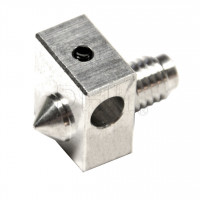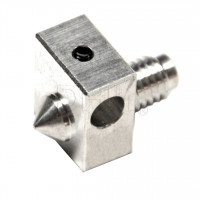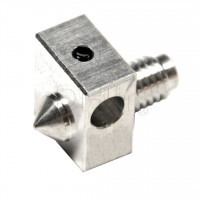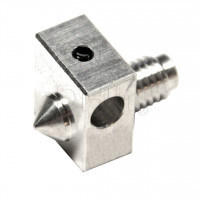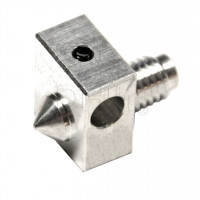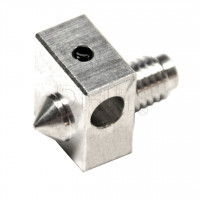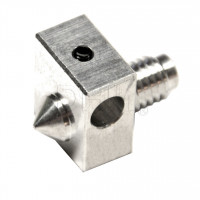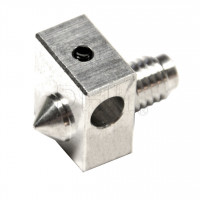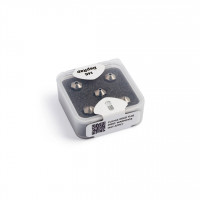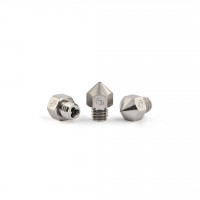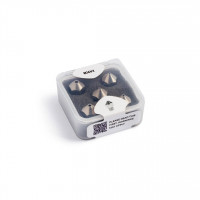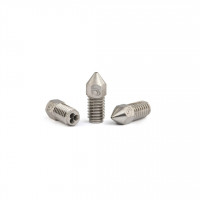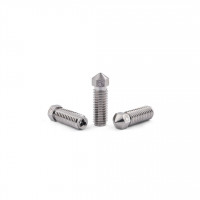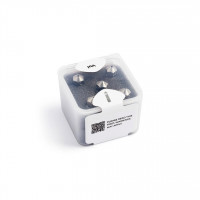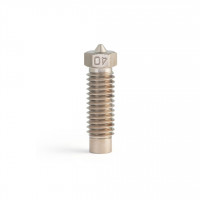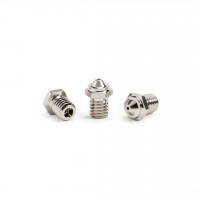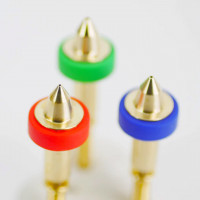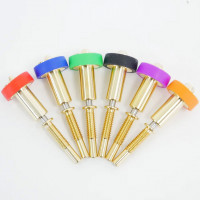
The nozzle is the smallest and most underrated component of a 3D printer, yet it directly influences the quality, speed and range of materials that can be used. A worn or unsuitable nozzle is the hidden cause of many printing problems.
Nozzle materials
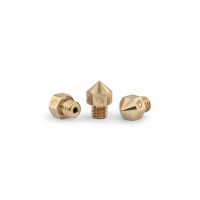
Brass
Brass is the standard material for the vast majority of nozzles. It offers excellent thermal conductivity (which means more uniform temperatures and more consistent melting), low cost and easy processing. It is perfect for PLA, PETG, ABS, ASA and all non-abrasive materials. Its limitation is its low hardness: filaments loaded with fibres (CF, GF) or particles (glow-in-the-dark, metal-fill) wear it out quickly, enlarging the hole and degrading print quality.
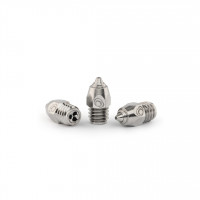
Hardened steel
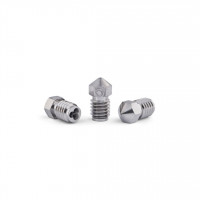
Hardened steel resists the abrasion of filled filaments and lasts enormously longer than brass with these materials. The trade-off is lower thermal conductivity: you may need a slightly higher temperature to achieve the same flux. It is the obvious choice for those who regularly print PA-CF, PETG-GF, glow-in-the-dark and metal-fill.
Stainless steel
Good abrasion and corrosion resistance, also suitable for food-safe applications. Intermediate thermal conductivity between brass and hardened steel.
Ruby and tungsten carbide
The hardest materials available for nozzles. Virtually unlimited durability even with the most abrasive filaments. High cost, only justified for intensive use with fibre-filled materials or industrial applications.
Diameters: which to choose
|
Diameter |
Layer recommended height |
Detail |
Speed |
Typical use |
|
0.2 mm |
0.05-0.12 mm |
Maximum |
Very slow |
Miniatures, jewellery, fine details |
|
0.4 mm |
0.1-0.28 mm |
High |
Standard |
General use (the default) |
|
0.6 mm |
0.15-0.4 mm |
Good |
Fast |
Good compromise speed/detail |
|
0.8 mm |
0.2-0.56 mm |
Medium |
Very fast |
Structural parts, pots, rapid prototypes |
When to replace the nozzle
Signs that indicate a nozzle that needs to be replaced are: unexplained under-extrusion despite correct parameters, inconsistent extrusion width (the hole has widened or deformed), degraded print surface compared to before, and frequent clogging that does not resolve with cleaning. With standard filaments and brass nozzle, replacement is recommended every 3-6 months of regular use. With hardened steel nozzles, every 12-18 months.
Nozzles at DHM-online
At DHM-online you will find nozzles of all materials and diameters, compatible with the main systems hotend: E3D V6, Revo, Bambu Lab, Creality, Bondtech and others. Browse the section Nozzles and Hotend to find the right replacement part for your printer.
Guide to 3D printing nozzles: materials and diameters
1. Why is the brass nozzle not suitable for filled filaments?
Brass is a relatively soft metal. When using filaments 'loaded' with abrasive particles (such as carbon fibre, glass fibre, metal powders or fluorescent pigments), these act like abrasive paper on the inside wall of the nozzle. Within a few hours of printing, the exit hole can widen and the tip shorten, compromising the diameter accuracy and height of layer. For these materials, it is essential to switch to a hardened steel nozzle.
2. What nozzle diameter to choose to maximise speed?
If the aim is to reduce printing times for structural parts or bulky prototypes, a 0.6 mm or 0.8 mm nozzle is the ideal choice. A larger diameter allows you to extrude a much larger amount of plastic per second (volumetric flow rate), enabling you to double the height of layer and halve the number of perimeters required to achieve the same strength compared to the standard 0.4 mm.
3. How does the nozzle material affect the printing temperature?
Thermal conductivity varies significantly between materials. Brass transfers heat very quickly, ensuring constant melting. Hardened steel, having a lower conductivity, tends to 'cool' faster during fast extrusions. In these cases, it is often necessary to increase the printing temperature by about 5-10°C above standard parameters to compensate for the lower thermal efficiency and maintain a smooth flow.
4. When is it worth investing in a nozzle with a Ruby or Tungsten Carbide tip?
These nozzles represent the top of the range for hobbyist or professional industrial printers. Although they have a high initial cost, they offer the thermal conductivity of brass combined with extreme surface hardness. They are a justified investment for those working hobbyistically or professionally with PA-CF (Nylon Carbon) 24 hours a day, as they eliminate the need to frequently recalibrate the Z-axis height due to nozzle wear.
5. What are the signs of a 'cooked' or worn nozzle?
A nozzle that has exceeded its life cycle shows obvious signs: the diameter of the extruded filament is no longer uniform, there are episodes of under-extrusion (holes in the walls) even if the extruder does not slip, and the tip appears visibly flat or asymmetrical. If you notice that fine details are no longer as defined as they used to be, it is time to consult the dedicated section on DHM-online to find the nozzle compatible with your hotend (E3D, Revo, Bambu Lab or Creality).