The 3D printer in a school should not remain confined to the technology classroom. The richest and most educational experiences arise when 3D printing is used transversally, as a tool in the service of several disciplines. In this article we see concrete applications for each area STEM, with tested examples in real schools.
Design & Technology: the natural heart
The Design & Technology department is the natural starting point: CAD software (such as Tinkercad, Fusion 360, FreeCAD) is already part of the curriculum and the learning curve for 3D printing is minimal. Students can design and print functional prototypes (supports, containers, mechanisms), iterate quickly on designs (modify, reprint, test), understand manufacturing constraints (tolerances, orientation, supports), and experiment with different materials (PLA for aesthetics, PETG for functionality, TPU for flexibility).
Science: tangible models
Science departments use the 3D printer to make otherwise abstract concepts tangible. Biology: animal and plant cell models, DNA double helix structure, anatomical models (eye, ear, heart). Chemistry: molecular models with coloured atoms and bonds (water, CO₂, glucose, crystal structures). Physics: 3D printed sine waves, models of magnetic fields, components for experiments (supports, guides, fittings). An effective approach is to use free model libraries such as Printables and Thingiverse for initial projects, then have students design original models as they acquire skills CAD.
Mathematics: visualising 3D
Mathematics is the subject where 3D printing offers perhaps the biggest qualitative leap. Printing Platonic solids, polyhedra, and rotational solids transforms abstract concepts into manipulable objects. 3D printed graphs of two-variable functions (z = f(x,y)) make concepts such as maxima, minima and saddle points intuitive. The three-dimensional Pythagorean theorem, trigonometry applied to real structures and conic sections become physical experiences. The technical challenge is that 3D graphics require print media, but with soluble materials (PVA) or Bambu Lab's multi-material printers this limitation is overcome.
Projects STEM interdisciplinary
The most formative experiences arise from projects that cross several disciplines. An example: designing a water rocket (physics: aerodynamics and propulsion, mathematics: trajectory calculation, design: ogive design CAD, technology: 3D printing and assembly). Or build a weather station (science: meteorology, technology: Arduino and sensors, design: 3D printed envelope, mathematics: data analysis). These projects activate transversal skills: teamwork, problem-solving, project management and communication.
Success factors
Schools that have successfully integrated 3D printing report some common factors. Teacher training is crucial: not only on the technical use of the printer, but on teaching approaches. Non-contact planning time is needed for teachers to prepare activities. Technical support (from the manufacturer and internal staff) is essential in the early stages. The step-by-step approach works: start with demonstrations and small objects, then progress to complex projects. And finally, sharing results among colleagues multiplies the impact.
Printers and materials for the laboratory STEM at DHM-online
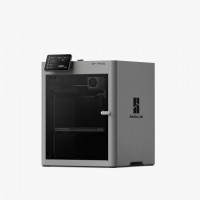
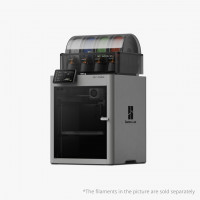
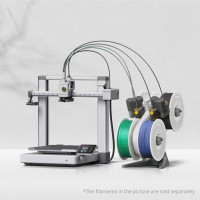
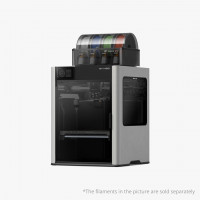
On DHM-online you will find everything you need to set up a complete laboratory STEM: Bambu Lab printers (A1 for low budgets, P2S for advanced performance), PLA filaments in dozens of colours, technical filaments (PETG, TPU), Arduino and Raspberry Pi boards for IoT projects, and mechanical components for constructions and prototypes. All purchasable via MEPA.
3D printing applications in materials STEM
1. How does 3D printing help the learning of mathematics?
3D printing transforms mathematics from a purely abstract discipline to a tactile experience. It makes it possible to materialise rotational solids, complex polyhedra and graphs of three-dimensional functions ($z = f(x,y)$). Touching a saddle point or a relative maximum helps students intuitively understand analytical geometry and infinitesimal calculus, visualising concepts that in the book would remain confined to an often ambiguous two-dimensional representation.
2. What are the most effective scientific models to print at school?
In biology, printing models of cells in cross-section or of the DNA double helix makes it possible to explore cell compartmentalisation and chemical bonds on a macroscopic scale. In physics, it is possible to print components for customised experiments, such as air-cushion rail carts or optical lens holders. The use of tangible models reduces cognitive load and increases long-term memorisation of biological structures and physical principles.
3. How can CAD and 3D printing be integrated into the Technology department?
The Design & Technology department acts as a central hub. Here, students learn how to use software such as Tinkercad or Fusion 360 to go from idea to prototype. 3D printing teaches real-world constraints: mechanical tolerances, material resistance (difference between PLA and PETG) and optimisation of structures. This approach prepares students for modern industrial workflows, where rapid prototyping is an essential stage of product development.
4. Is it possible to realise interdisciplinary projects with a single 3D printer?
Certainly. A single project can involve several subjects STEM simultaneously. For example, the construction of a weather station requires: design of the enclosure (Technology/Design), integration of sensors and boards Arduino (Electronics), analysis of collected data (Mathematics) and study of atmospheric phenomena (Science). This method, known as Project-Based Learning, motivates students by showing the practical usefulness of individual disciplines in a real and complex context.
5. What is needed to set up a laboratory STEM that really works?
In addition to a reliable and fast printer such as the Bambu Lab A1 or P1S, it is essential to have a variety of filaments (coloured PLA for teaching models and PETG for functional parts) and a supply of electronic components such as Arduino or Raspberry Pi. On DHM-online, schools can purchase complete kits via MEPA, also benefiting from the technical support needed for teacher training and proper maintenance of the lab, ensuring that the technology remains an active tool and not an ornament.