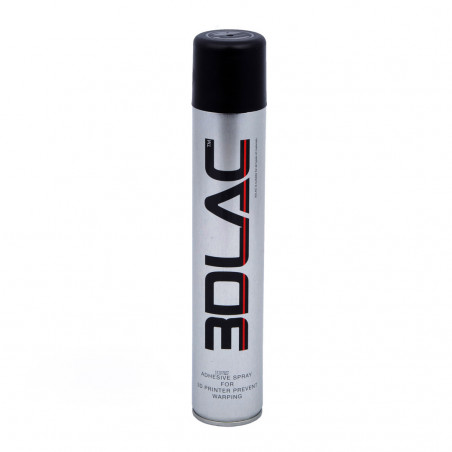
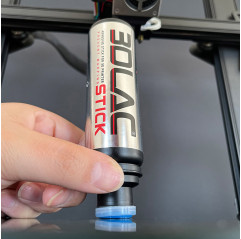
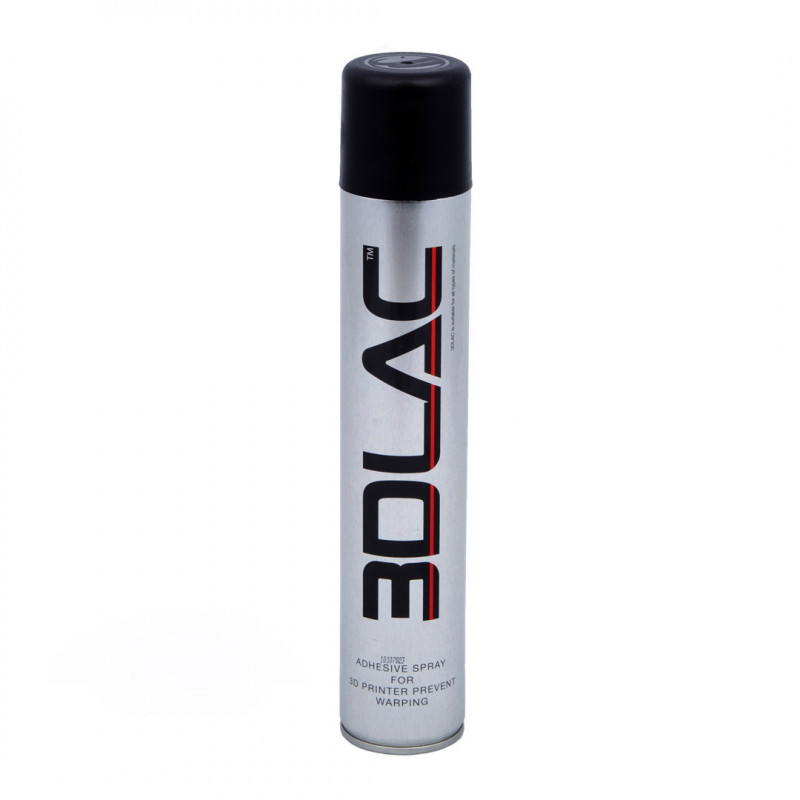
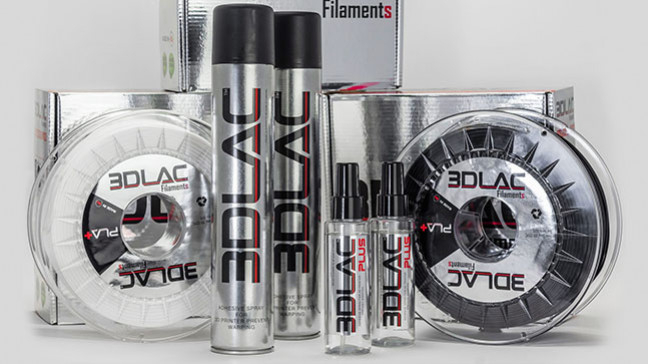
3DLAC is an ultra fast drying thermoplastic copolymer based lacquer.
3DLAC has the function of holding the first layer of printed plastic firmly to the surface being used, preventing unwanted errors.
3DLAC is the perfect replacement for Kapton and other types of fixatives due to its cost savings and easy application.
A light mist of 3DLAC on the surface is enough to completely hold the first layer to the base.
Due to the properties of 3DLAC, while the base is hot the extruded plastic is firmly attached.
Once the molded part cools, it can be removed smoothly and without damage.
FEATURES
Ultra fast drying
Excellent adhesion
Long life (over 400 uses)
Ease of application
Water cleaning
Good anti-warping performance with various materials such as ABS, PLA, PETG ...
Adhesion on any surface
Intelligent fixing properties
Product recognized by the Spanish Toxicological Institute
APPLICATIONS
3DLAC can be applied to a multitude of materials, on which you want to print with 3D printers. Depending on the material, different adhesions can be obtained. It is recommended to do some testing before printing large parts with certain technical materials. A larger amount of spray helps make the adhesion stronger. When removing parts, pay special attention to how you do it, it is recommended to let the surface cool and, if necessary, give the part a light tap to loosen it easily.
INSTRUCTIONS FOR USE
Shake the spray very well before use, for about one minute.
Apply to clean, dry surfaces. Recommended for glass, mirrors, aluminum and any smooth surface. On plastic surfaces, it is recommended to test the behavior of the product first.
Apply a thin layer for best results.
Turn diffuser upside down to purge valve after use.
If the diffuser is clogged, use a cotton swab to apply a small amount of alcohol to the nozzle.
Always use in ventilated areas.
Avoid applying to electronic devices.
After use, clean the speaker to keep it in good condition and prevent clogging.
Avoid use by children.
TECHNICAL SPECIFICATIONS
Type of binder: thermoplastic
Color: Transparent
Glossiness (ASTM D-523 ISO 2813): Not applicable
Dry to touch (ASTM D-1640 ISO 1517): 10''
Total Dryness (ASTM D-1640 ISO 1517): 1''
Dry film thickness ( ASTM D-823 ISO 2808 ): 15 µ/layer
Adhesion ( ASTM D-3359 ISO 2409 ): 4 B
Theoretical coverage (continuous spray): 2 m²
Thinner: Isopropyl alcohol
Product life: >5 years
Overlap: Yes
Heat resistance: 200ºC
Application conditions: Minimum room temperature: 8ºC / Surface temperature from 5ºC to 180ºC / Maximum humidity 85% R.H.P.
The item you will receive may differ in some features from the one represented in the photo, depending on the production batch. Despite this, the functionality is maintained.
Hello. 3dlac-spray,...do i have to spray it onto the cold build plate before the print or do i heat up the bed and spray it onto the hod bed and start the print.
Hello, here is the procedure:
Shake well for 1 min before use.
Apply to clean, dry, cold surfaces (glass, mirrors, aluminum, smooth surfaces). Test on plastic first.
Use a thin layer for best results.
After use, turn diffuser upside down to purge valve.
If clogged, clean nozzle with alcohol using a cotton swab.
Use in ventilated areas. Avoid electronics.
Clean the speaker after use to prevent clogging.
Place the plate on the printer and start printing.
Qual è il materiale migliore per pezzi che devono stare all'esterno?
L'ASA è il materiale consigliato per l'uso esterno. A differenza dell'ABS, l'ASA è altamente resistente ai raggi UV, non ingiallisce e mantiene le sue proprietà meccaniche anche sotto l'esposizione diretta del sole e degli agenti atmosferici.
Perché la mia stampa in PETG presenta molti "fili" (stringing)?
Il PETG è un materiale molto viscoso. Per ridurre lo stringing, è fondamentale calibrare correttamente la temperatura di stampa e la distanza di ritrazione. Inoltre, assicurati che il filamento sia asciutto, poiché l'umidità assorbita peggiora drasticamente questo fenomeno.
Posso mescolare resine di marche diverse?
In generale è sconsigliato, poiché ogni resina ha tempi di esposizione e composizioni chimiche differenti. Mescolarle potrebbe portare a fallimenti di stampa o a una polimerizzazione incompleta del pezzo.
Come si smaltiscono i residui di resina 3D?
La resina liquida è considerata un rifiuto speciale. Non deve mai essere gettata negli scarichi domestici. È necessario polimerizzare i residui liquidi (esponendoli al sole o a lampade UV) fino a renderli solidi, dopodiché possono essere smaltiti seguendo le normative locali sui rifiuti plastici speciali.
Qual è la differenza tra una piastra in alluminio normale e una rettificata 5083?
La piastra normale può presentare curvature invisibili all'occhio ma enormi per l'ugello di una stampante 3D. La piastra 5083 rettificata è lavorata meccanicamente per essere perfettamente piana e distesa termicamente, il che significa che non si "imbarcherà" mai quando la riscaldi a 80-100°C.
Posso incollare un tappetino riscaldante direttamente sulla piastra magnetica?
No, il tappetino riscaldante deve essere applicato sulla parte inferiore della piastra rigida (alluminio). La superficie magnetica va applicata sulla parte superiore. Il calore passerà attraverso l'alluminio e la base magnetica per scaldare la superficie in PEI o acciaio.
Come si pulisce correttamente una superficie in PEI?
Per mantenere l'adesione al massimo, è sufficiente pulire la superficie con alcool isopropilico (IPA) tra una stampa e l'altra. Se l'adesione cala drasticamente dopo molti utilizzi, un lavaggio con acqua tiepida e sapone neutro per piatti aiuterà a rimuovere i residui grassi delle dita.
È necessario isolare il piano di stampa sotto il riscaldatore?
Non è obbligatorio, ma è caldamente consigliato. L'isolamento riduce i tempi di riscaldamento del 30-50% e mantiene la temperatura molto più stabile, evitando che il calore residuo interferisca con il funzionamento dei sensori o dei motori situati sotto il piano.