Worldwide express shipping
- My DHM
- +Products
- +Mechanical components
- +Profiles structural and accessories
- +Hardware and Screws
- +Industrial material
- +Robotics and Automation
- Motor driver
- Relays and switches
- Power supplies
- Modules and card expansions
- Fans
- Parts for cards
- Control cards
- Arduino boards
- Integrated computers and development boards
- Spies and warning lights
- Duet 3D
- Arduino compatible
- Optoelectronics
- Passive components
- Thermal management
- Video surveillance
- Sensors
- Batteries and Chargers
- Semiconductors
- PCB Prototyping
- Motors
- Data storage and connectivity
- CNC Machines
- +Electrical equipment
- +Extruder group - 3D printing
- +Print bed - 3D print
- +Filaments and 3D Resins
- PLA
- Special PLA
- Loaded
- PETG
- Co-polyesters
- PP - Polypropylene
- Eraser
- PA - Polyamide
- ASA
- ABS
- Special ABS
- PC - Polycarbonate
- PVA and supports
- HIPS
- SKIN contact
- PEI - Polyetherimide
- PMMA
- PPSF & PSU - Polyphenylsulfone
- Accessories - filaments
- PELLETS
- Resins
- Brands Filaments and 3D Resins
- PEKK & PEEK
- PE - Polyethylene
- PVDF - Polyvinylidene fluoride
- ESD-Safe
- PACKS
- +3D printers
- +Tailor-made workings and kits
- Gift Cards
- CLEARANCE
- Manufacturers
- DHM online services
- New Products
- Prices Drop
- My Projects
- Blog
- Contact Us
- Help
- Product Details
- Description
LW-ASA
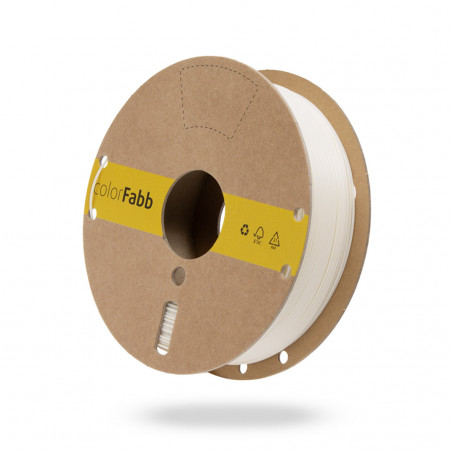
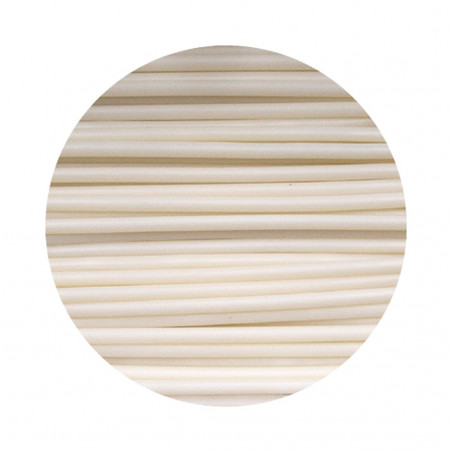
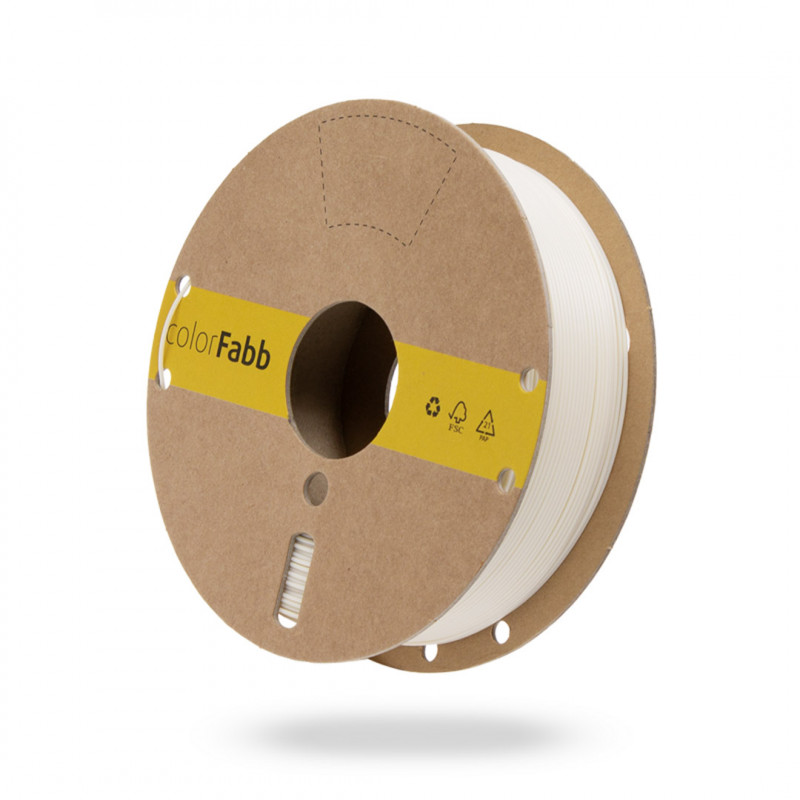
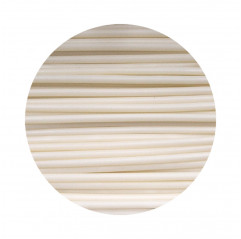
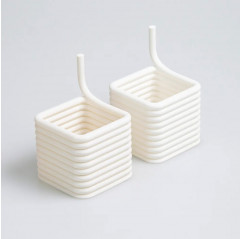
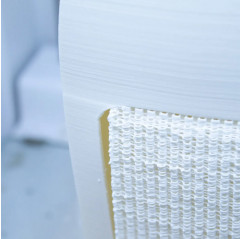
This is the most basic version of LW-ASA, with no added dyes: just the natural color of ASA, slightly off-white. Once expanded, the surface finish becomes matte.
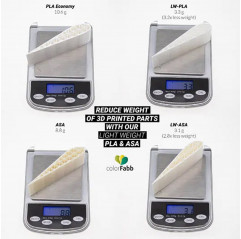
The LW-ASA material is capable of increasing its volume up to about 2.5 times. The density of the filament is about 1.07 g/cm³, but when expanded to maximum capacity a part density around 0.43 g/cm³ can be achieved.
Like traditional ASA, LW-ASA offers high UV stability and a heat resistance of 96°C. You can be sure that this material will withstand high temperatures better than our LW-PLA.
LW-ASA is more prone to warping than LW-PLA filaments. In particular, patterns with a large surface area may shrink and warp during printing, although usually to a lesser extent than ABS.
Note that color variations may occur: when the material is in its maximum expansion, the color tends to be lighter than in its unexpanded state, where it appears deeper and more intense.
In addition to using a large brim and a top heated to 90-100°C (or higher, if your machine allows it), we can also recommend the following: print a high skirt around the model to reduce the flow of cold air around the print, or print inside an enclosure for better environmental temperature control.
Specifications
- Material: colorFabb - LW-ASA
- Diameter tolerance: ± 0.1 mm
- Density: 1.07 g/cm³ (unfoamed) - 0.43 g/cm³ (foamed, printed at 40% flow rate)
- Vicat softening temperature: 96°C
- Recommended printing temperature: 240-260°C
- Recommended printing speed: 30-50 mm/s
- Recommended heated platen: 90-100°C
- Cooling fan: To reduce warping we recommend using the least amount of cooling possible. Also, to achieve the best mechanical performance, it is preferable to print with the least amount of cooling required, so as to ensure optimal adhesion between layers.
Package contains: 1 x LW-ASA NATURAL 1.75mm 650g - ColorFabb
- Read more
For more information please contact us.
The item you receive may differ in some features from the one depicted in the photo, depending on the production batch. Despite this, functionality is maintained.
- Video
- Questions(FAQs)
L'ASA è il materiale consigliato per l'uso esterno. A differenza dell'ABS, l'ASA è altamente resistente ai raggi UV, non ingiallisce e mantiene le sue proprietà meccaniche anche sotto l'esposizione diretta del sole e degli agenti atmosferici.
Il PETG è un materiale molto viscoso. Per ridurre lo stringing, è fondamentale calibrare correttamente la temperatura di stampa e la distanza di ritrazione. Inoltre, assicurati che il filamento sia asciutto, poiché l'umidità assorbita peggiora drasticamente questo fenomeno.
In generale è sconsigliato, poiché ogni resina ha tempi di esposizione e composizioni chimiche differenti. Mescolarle potrebbe portare a fallimenti di stampa o a una polimerizzazione incompleta del pezzo.
La resina liquida è considerata un rifiuto speciale. Non deve mai essere gettata negli scarichi domestici. È necessario polimerizzare i residui liquidi (esponendoli al sole o a lampade UV) fino a renderli solidi, dopodiché possono essere smaltiti seguendo le normative locali sui rifiuti plastici speciali.
7 Similar Products:
Added to your Project
Removed from your Project
Added to your Project
Removed from your Project
Added to your Project
Removed from your Project
Added to your Project
Removed from your Project
Added to your Project
Removed from your Project

- Images