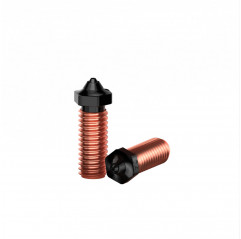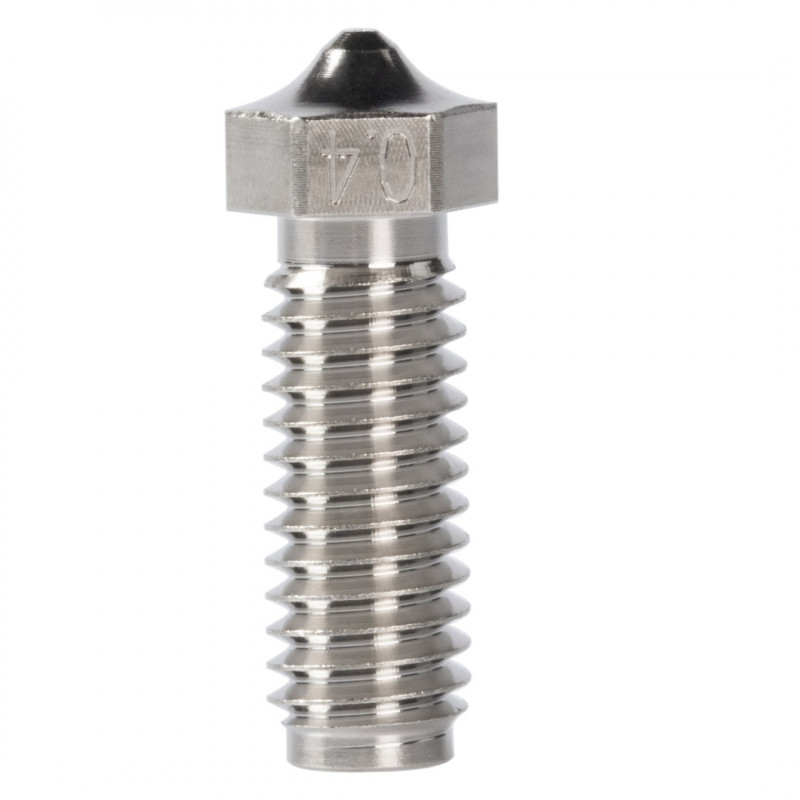
Temperature resistance up to 500℃, the best choice for engineering plastics such as PEEK.
High material thermal performance maintains uniform nozzle temperature during printing, thus ensuring stable extrusion; Meanwhile, it further improves printing speed without sacrificing quality.
Special processing technology and post-processing make the nozzle burr-free at the tip edge and debris-free in the bore.
Inner hole roughness less than Ra0.4 and the entire nozzle nickel-plated, improved smoothness and lower friction.
Superior copper alloy with high strength and high thermal conductivity ensures high performance.
Application:
Works well for high temperature applications, printing with materials such as PEEK, PEKK, PEI, PSU, PPSU and etc.
Package Contains: 1 x PH Plated Copper Nozzle 1.75mm
Specifications:
Min. diameter: d.0.25
Tolerance: ±0.01mm
Roughness of inner hole: ≤Ra0.4μm
Concentricity: ≤0.02mm
For more information please contact us.
The item you receive may differ in some features from the one depicted in the photo, depending on the production batch. Despite this, the functionality is maintained.
Oggetto SKU: 19560071: Non sono riuscito a trovare i dati circa la filettatura (passo metrico e lunghezza) del nozzle indicato. Si potrebbero avere per verificare la compatibilità con la mia stampante? Grazie.
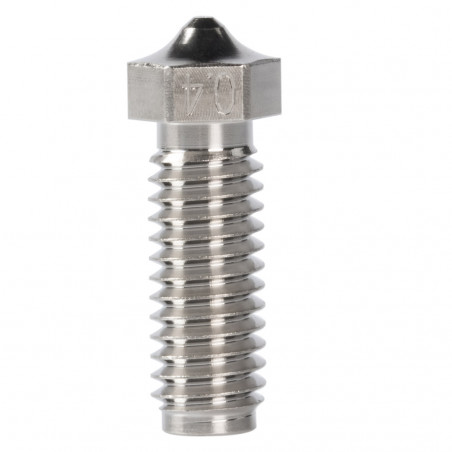
Filettatura: M6x1 (passo metrico grosso)
Lunghezza Filetto: 14.5mm
Qual è la differenza tra un estrusore Single Drive e uno Dual Drive?
L'estrusore Single Drive utilizza un solo ingranaggio motorizzato e un cuscinetto a pressione. Il sistema Dual Drive utilizza due ingranaggi controrotanti che afferrano il filamento da entrambi i lati, garantendo una forza di spinta doppia e riducendo drasticamente lo slittamento, specialmente con filamenti tecnici o velocità elevate.
Quando dovrei sostituire l'ugello (nozzle)?
L'ugello va sostituito quando si notano problemi di stampa, specialmente superficiali, o se il diametro del foro si è allargato a causa dell'usura (comune con materiali abrasivi). Un ugello in ottone usato con fibra di carbonio può rovinarsi in poche ore di stampa, mentre uno in acciaio temprato può durare mesi.
Perché il mio estrusore scatta (fa rumore di "clic") durante la stampa?
Il rumore di scatto indica che il motore non riesce a spingere il filamento. Le cause, tra le altre, possono essere un ugello parzialmente ostruito, una temperatura di stampa troppo bassa, o una velocità di estrusione eccessiva per le capacità termiche del tuo hotend, un meccanismo non adeguato al tipo di filamento utilizzato.