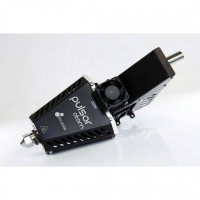
3D pellet printing is not just about industrial productivity. For universities and research centres, it represents a unique opportunity to explore materials, processes and applications that filament printing cannot achieve. Dyze Design Pulsar and Pulsar Atom extruders are the ideal tools for this type of research.
Materials research: the killer application
The most significant advantage of pellet printing in academia is the possibility of working directly with granules, the same format used in injection moulding. This opens up scenarios that are impossible with filament: formulation and testing of custom compounds in small quantities, study of the rheological behaviour of new polymer blends, research into recycled materials and the circular economy (pellets from recycled plastic cost very little), experimentation with functional fillers (fibres, metal powders, ceramics), and validation of new materials prior to filament production.
Big format for big ideas
The Pulsar™, with its 2.5 kg/hour capacity, transforms a large-format printer into a machine capable of producing full-scale prototypes in hours instead of days. For faculties of architecture, industrial design and engineering, it means being able to produce mock-ups, moulds and structural components that previously required expensive and slow external machining.
Circular economy and sustainability
Pellet printing is inherently more sustainable: recycled granules are readily available and at very low cost, the process eliminates the filament extrusion step (less energy, less transport), and it is possible to use production waste directly as printing material. For environmental engineering and materials science departments, this is a research platform in itself.
Recommended setup for a laboratory
To integrate pellet printing into a university lab, you need a Dyze extruder (Pulsar for large format or Pulsar Atom for compact format), a large-format 3D printer or robotic arm on which to mount the extruder, a compatible control board (Duet3D, controller with Klipper or Marlin firmware), a hopper for feeding pellets (included or optional), and pellets of various materials for experimentation. At DHM-online you will find all these components, including pellets Formfutura and boards Duet3D.
Purchasing via MEPA
Dyze Design extruders and all related components can be purchased via MEPA at DHM-online. We offer customised quotations for the complete lab set-up, including extruder, electronics, start-up materials and accessories. Contact the DHM team for assistance.
Frequently asked questions about 3D pellet printing for research and academia
1. What are the advantages of 3D pellet printing over filament in research?
Pellet printing allows thermoplastic granules used in injection moulding to be used directly, eliminating the cost and limitations of processing into filament. For a research centre, this means being able to test custom polymeric compounds, study low-cost recycled materials and experiment with functional fillers (carbon fibres, metal powders or ceramics) that would be impossible to handle in a spool format due to their fragility or viscosity.
2. Pulsar vs Pulsar Atom extruder: which one to choose for the laboratory?
The choice depends on the scale of the design. The Dyze Design Pulsar™ is designed for large format printing, with an extrusion capacity of up to 2.5 kg/hour, ideal for architectural prototypes or large-scale industrial moulds. The Pulsar Atom, on the other hand, is the compact version, optimised for those requiring high precision on medium volumes or for integration on professional desktop printers and small robotic arms, while retaining the flexibility to process almost any type of pellet.
3. Is it possible to do a circular economy with pellet printing in universities?
Absolutely. Pellet printing is the enabling technology for the circular economy in environmental engineering departments. Laboratory or post-consumer plastic waste can be shredded and directly transformed into new printed objects. Since recycled pellets cost up to ten times less than virgin filament, laboratories can conduct massive material sustainability experiments with minimal economic impact on the project budget.
4. How do you integrate a pellet extruder on a robotic arm or CNC?
Integration requires a flexible control system such as Duet3D boards or Klipper firmware-based controllers, available at DHM-online. Thanks to the industrial design of Dyze extruders, mechanical mounting on robotic arms or CNC portals is simplified. This configuration overcomes the limitations of traditional print volumes, enabling additive manufacturing of metric-sized components with complex geometries and high-performance engineering materials.
5. How can Dyze Design extrusion systems be purchased through MEPA?
All components for pellet printing, including Pulsar extruders, Duet electronics and Formfutura pellets, can be found in the DHM-online catalogue on MEPA. Universities and public bodies can request customised quotations for 'research packages' including the extruder, pellet feed system (hopper) and starter materials. The DHM team provides full support for the coding of tendered products and all institutional electronic invoicing procedures.