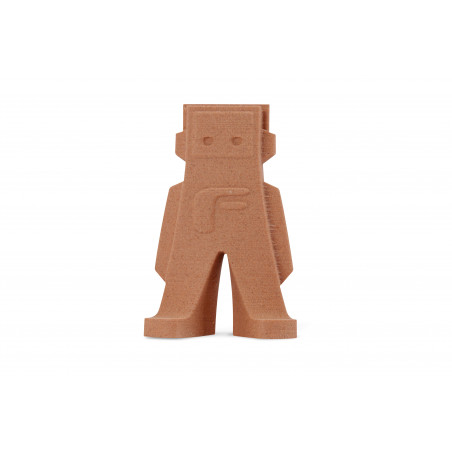
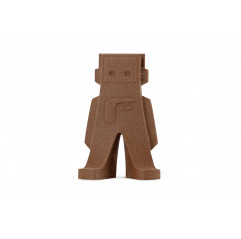
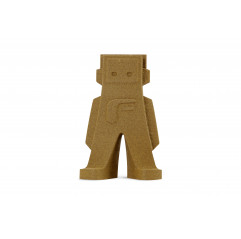
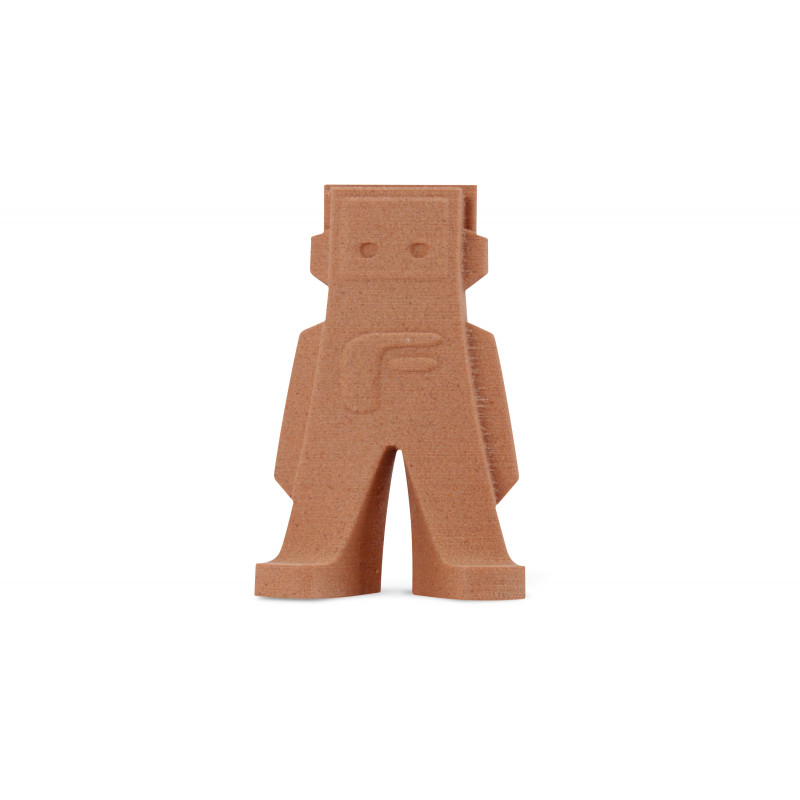
EasyWood has the look, texture and smell of real wood. A beautiful woodgrain effect can be achieved by sanding the printed object with fine-grit sandpaper. Alternatively, the same effect can be achieved by varying the printing temperature during the process.
EasyWood is a PLA-based filament with 40% ground wood particles. The wood particles also contribute to a print free of warping.
Unique characteristics
Very high wood content: 40%
Authentic wood look, feel and smell
Very easy to print
Print free of warping and without deformation after cooling
Excellent thermal stability and good filament fluidity
Perfect adhesion of first layer and between layers layer
Printable at high speeds
Grain effect achievable by sanding with fine sandpaper
Grain effect achievable by varying the print/extrusion temperature
Biodegradable
General printing guidelines *
Nozzle diameter: ≥ 0.4 mm
Height layer: ≥ 0.2 mm
Flow rate: ± 100%
Print temperature: ± 190 - 240 °C
Print speed: 20-45 mm/s
Shrinkage: Yes ± 5 mm
Heated plate: ± 50 - 60 °C
Fan speed: 80-100%.
Experience level: Beginner
*) The above settings are intended as guidelines for finding optimal printing parameters. These ranges should work with most printers, but feel free to experiment outside these values if you feel it is suitable for your printer. There are many different types of printers, hot-end and offset, so it is extremely difficult to provide a universal setting that applies to all.
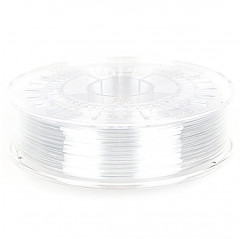
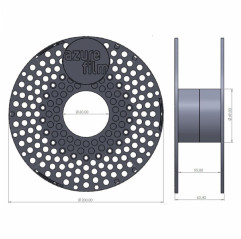
Filament length
ρ: 1.20 g/cc
Spool 50 g
Spool 0.5 kg
Spool 2,3 Kg
Ø 1.75 mm
± 17,3 m
± 173 m
± 797 m
Ø 2.85 mm
± 6,5 m
± 65 m
± 300 m
Nozzle Cleaning
When printing with filled or composite filaments, it is recommended to clean the nozzle immediately after printing by passing 15-20 cm of PLA filament through it. This ensures the expulsion of any filler residue. It is even more effective to use PLA Glow in the Dark, as the extremely hard phosphorous particles are more likely to remove any internal residue from the nozzle.
Package contains: 1 x EasyWood - Cedar- Formfutura
The item you receive may differ in some features from the one shown in the photo, depending on the production batch. Despite this, functionality is maintained.
Qual è il materiale migliore per pezzi che devono stare all'esterno?
L'ASA è il materiale consigliato per l'uso esterno. A differenza dell'ABS, l'ASA è altamente resistente ai raggi UV, non ingiallisce e mantiene le sue proprietà meccaniche anche sotto l'esposizione diretta del sole e degli agenti atmosferici.
Perché la mia stampa in PETG presenta molti "fili" (stringing)?
Il PETG è un materiale molto viscoso. Per ridurre lo stringing, è fondamentale calibrare correttamente la temperatura di stampa e la distanza di ritrazione. Inoltre, assicurati che il filamento sia asciutto, poiché l'umidità assorbita peggiora drasticamente questo fenomeno.
Posso mescolare resine di marche diverse?
In generale è sconsigliato, poiché ogni resina ha tempi di esposizione e composizioni chimiche differenti. Mescolarle potrebbe portare a fallimenti di stampa o a una polimerizzazione incompleta del pezzo.
Come si smaltiscono i residui di resina 3D?
La resina liquida è considerata un rifiuto speciale. Non deve mai essere gettata negli scarichi domestici. È necessario polimerizzare i residui liquidi (esponendoli al sole o a lampade UV) fino a renderli solidi, dopodiché possono essere smaltiti seguendo le normative locali sui rifiuti plastici speciali.