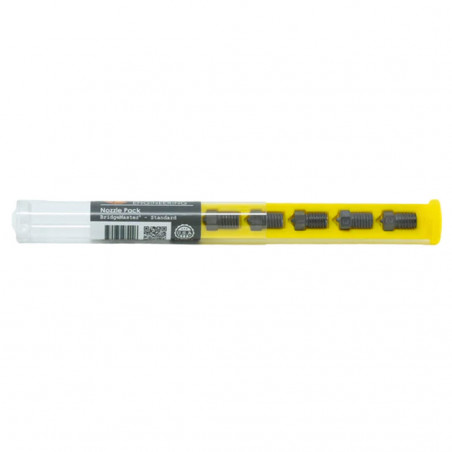
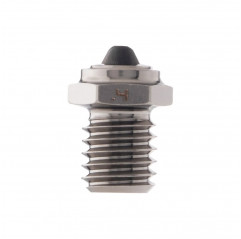
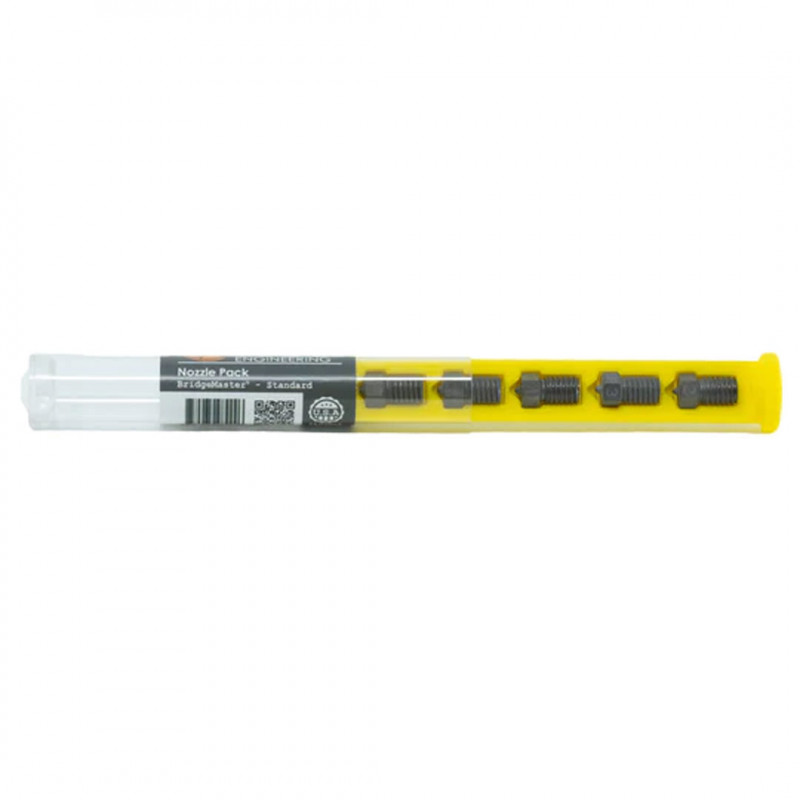
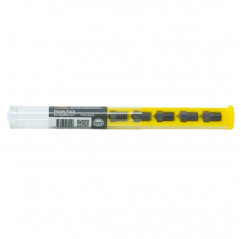
With the Nozzle Pack from Slice Engineering you have different nozzle sizes for a rapido change. Each nozzle from Slice Engineering has engraved on the sides the size of the filament exit hole.
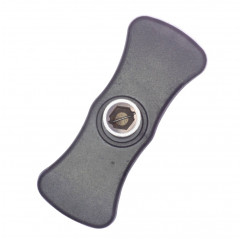
Assembly is simple. You can use 6 mm metric socket wrenches, and standard 1/4 in. wrenches.
You can choose either the Vanadium or BridgeMaster model, with different sizes.
Both types are Rep Rap style, so they have an M6 x 1.0 thread with a thread length of 7 mm and overall length of 12.5 mm.
What are the differences between Vanadium and BridgeMaster?
Vanadium nozzles from Slice Engineering are hardened and tempered to 65 Rockwell C. These nozzles have abrasion resistance even at printing temperatures, not just room temperature. The surface is coated with a wear-resistant repellent layer to keep the nozzle as clean as possible.
BridgeMaster nozzles offer the highest bridging performance. It has a copper alloy core optimized for thermal conduction. The surface coating is carbide-based and therefore very resistant to filament wear with non-plastic additives such as wood, glitter or bright.
There is a choice of two package types:
Standard package - 0.2 / 0.3 / 0.4 / 0.5 / 0.6 mm nozzles
The item you receive may differ in some features from the one depicted in the photo, depending on the production batch. Despite this, functionality is maintained.
Qual è la differenza tra un estrusore Single Drive e uno Dual Drive?
L'estrusore Single Drive utilizza un solo ingranaggio motorizzato e un cuscinetto a pressione. Il sistema Dual Drive utilizza due ingranaggi controrotanti che afferrano il filamento da entrambi i lati, garantendo una forza di spinta doppia e riducendo drasticamente lo slittamento, specialmente con filamenti tecnici o velocità elevate.
Quando dovrei sostituire l'ugello (nozzle)?
L'ugello va sostituito quando si notano problemi di stampa, specialmente superficiali, o se il diametro del foro si è allargato a causa dell'usura (comune con materiali abrasivi). Un ugello in ottone usato con fibra di carbonio può rovinarsi in poche ore di stampa, mentre uno in acciaio temprato può durare mesi.
Perché il mio estrusore scatta (fa rumore di "clic") durante la stampa?
Il rumore di scatto indica che il motore non riesce a spingere il filamento. Le cause, tra le altre, possono essere un ugello parzialmente ostruito, una temperatura di stampa troppo bassa, o una velocità di estrusione eccessiva per le capacità termiche del tuo hotend, un meccanismo non adeguato al tipo di filamento utilizzato.