
Discover all our ready-to-use configurators for semi-finished products according to your needs
Find out more
assistant_photo
Worldwide express shipping
Menu
- My DHM
- +Products
- +Mechanical components
- +Profiles structural and accessories
- +Hardware and Screws
- +Industrial material
- +Robotics and Automation
- Motor driver
- Relays and switches
- Power supplies
- Modules and card expansions
- Fans
- Parts for cards
- Control cards
- Arduino boards
- Integrated computers and development boards
- Spies and warning lights
- Duet 3D
- Arduino compatible
- Optoelectronics
- Passive components
- Thermal management
- Video surveillance
- Sensors
- Batteries and Chargers
- Semiconductors
- PCB Prototyping
- Motors
- Data storage and connectivity
- CNC Machines
- +Electrical equipment
- +Extruder group - 3D printing
- +Print bed - 3D print
- +Filaments and 3D Resins
- PLA
- Special PLA
- Loaded
- PETG
- Co-polyesters
- PP - Polypropylene
- Eraser
- PA - Polyamide
- ASA
- ABS
- Special ABS
- PC - Polycarbonate
- PVA and supports
- HIPS
- SKIN contact
- PEI - Polyetherimide
- PMMA
- PPSF & PSU - Polyphenylsulfone
- Accessories - filaments
- PELLETS
- Resins
- Brands Filaments and 3D Resins
- PEKK & PEEK
- PE - Polyethylene
- PVDF - Polyvinylidene fluoride
- ESD-Safe
- PACKS
- +3D printers
- +Tailor-made workings and kits
- Gift Cards
- CLEARANCE
- Manufacturers
- DHM online services
- New Products
- Prices Drop
- My Projects
- Blog
- Contact Us
- Help
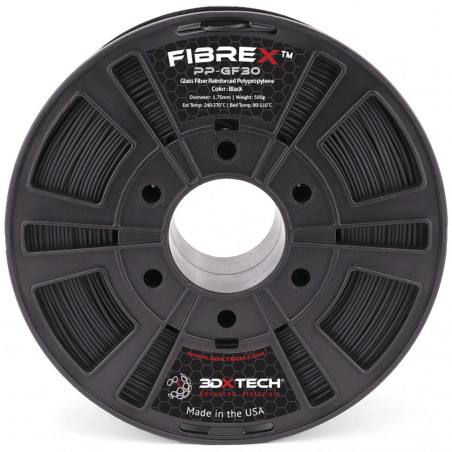
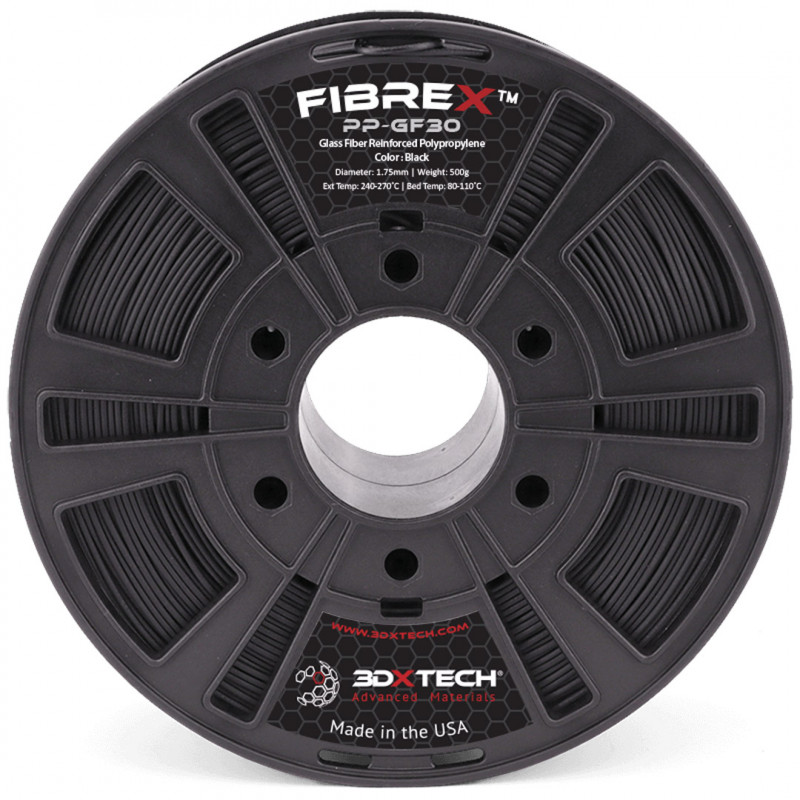
FIBREX PP+GF30 POLYPROPYLENE - Black / 1.75mm / 500g - 3DXTech

19210055
€81.20
Added to your Project
Removed from your Project
VAT included
Shipping excluded
Pre-order NowDelivery times indicated in stock details
- Product Details
- DescriptionPackage contains: 1 x FIBREX PP+GF30 POLYPROPYLENE - Black / 1.75mm / 500g - 3DXTech
FibreX? PP+GF30 is made using a specially formulated 30% glass fiber reinforced polypropylene copolymer created specifically for 3D printing. The formulation offers improved thermal properties and less contraction and deformation than competitive PP-based compounds.
Strengthening this trusted engineering polymer with glass fiber has truly made it a game changer for industrial applications. 3D printed PP+GF30 parts can be found in a wide range of real-world functional end uses or prototypes with automobiles, tooling and jigs, home appliances and sporting goods.
Advantages of PP+GF include:
Excellent resistance against a huge variety of chemicals
Low density and weight
Low shrinkage and warpage
Does not absorb moisture, no drying required!
High strength, stiffness and impact resistance
Chemical Resistance of PP+GF
Because properties can change depending on the printing environment and the geometry and/or surface of the 3D model, you should always perform your own tests, but polypropylene is known for its chemical resistances to a wide range of environments, including:
Acids: Acetic, Boric, Hydrochloric, Phosphoric, Stearic, Sulfuric, Uric
Bases: Ammonium, Barium, Calcium, Magnesium, Potassium, Sodium hydrocides
Solvents: Acetone, Ethanol, MEK, Phenol (10%), Water
Filament specifications:
Diameter: 1.75 mm (+/- 0.05 mm)
Recommended print settings:
Extruder: 240-270°C
Platen temperature: 80-110°C
Nozzle: we strongly recommend a hardened steel nozzle with a minimum diameter of 0.4 mm for abrasive materials such as this
Other: the ideal layer height is 60% of the nozzle diameter. We do not recommend printing layers smaller than 0.2 mm with abrasive filaments
Platen preparation: we recommend the use of an adhesive or poly tape
Heated chamber: not necessary
Media: AquaTek? Water Soluble X1 USM Universal Support Material is one of the few materials that can properly form a strong, temporary bond to the support. Polypropylene is notorious for being difficult to support and X1 USM is ideal for the job
Drying Instructions: not required
Abrasive Material
This material is particularly abrasive among 3D printing filaments. Users may find that standard brass nozzles are chewed up very quickly compared to standard wear. If worn, the nozzle diameter will expand inconsistently and the printer will encounter extrusion problems.
For this reason, we strongly recommend printing this material through a hardened steel nozzle rather than a softer metal. Hardened steel nozzles can often be inexpensive and easy to install depending on the printer manufacturer's instructions. - Read moreFor more information please contact us.
The item you will receive may differ in some features from the one represented in the photo, depending on the production batch. Despite this, the functionality is maintained. - Questions(FAQs)
L'ASA è il materiale consigliato per l'uso esterno. A differenza dell'ABS, l'ASA è altamente resistente ai raggi UV, non ingiallisce e mantiene le sue proprietà meccaniche anche sotto l'esposizione diretta del sole e degli agenti atmosferici.
Il PETG è un materiale molto viscoso. Per ridurre lo stringing, è fondamentale calibrare correttamente la temperatura di stampa e la distanza di ritrazione. Inoltre, assicurati che il filamento sia asciutto, poiché l'umidità assorbita peggiora drasticamente questo fenomeno.
In generale è sconsigliato, poiché ogni resina ha tempi di esposizione e composizioni chimiche differenti. Mescolarle potrebbe portare a fallimenti di stampa o a una polimerizzazione incompleta del pezzo.
La resina liquida è considerata un rifiuto speciale. Non deve mai essere gettata negli scarichi domestici. È necessario polimerizzare i residui liquidi (esponendoli al sole o a lampade UV) fino a renderli solidi, dopodiché possono essere smaltiti seguendo le normative locali sui rifiuti plastici speciali.
4 Similar Products:

€137.20Price
Added to your Project
Removed from your Project

€244.99Price
Added to your Project
Removed from your Project

€109.20Price
Added to your Project
Removed from your Project
arrow_back
arrow_forward
- Images