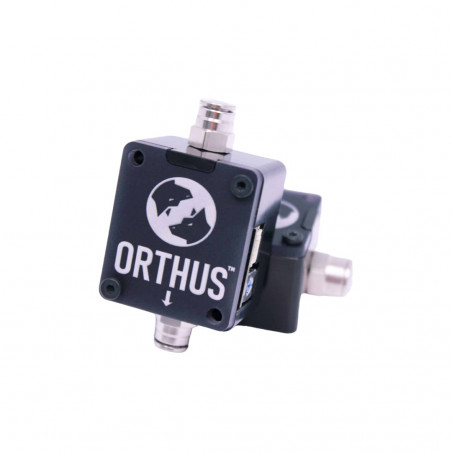
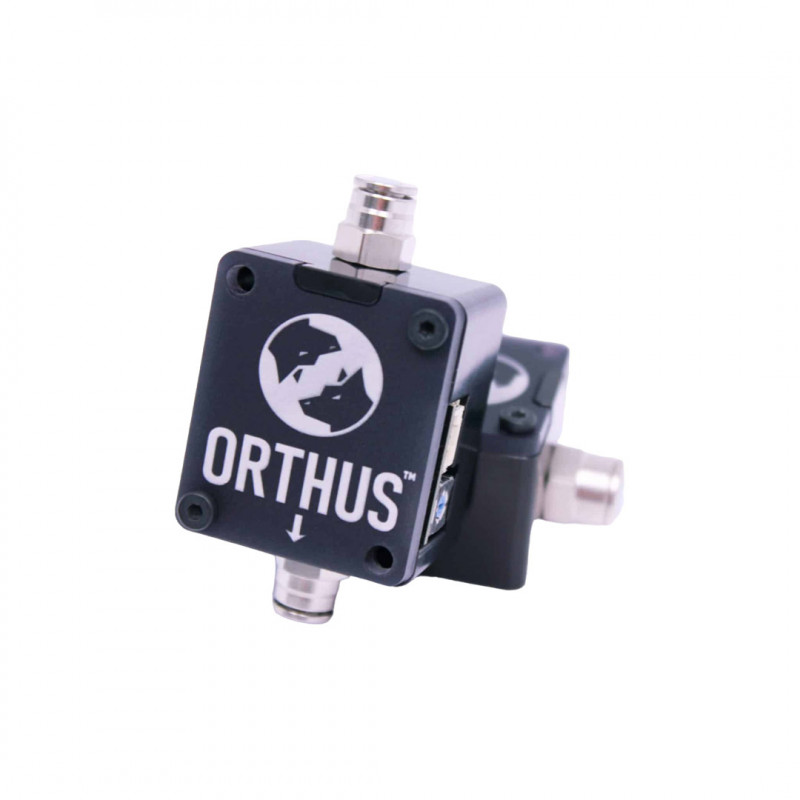
Orthus™ is an intelligent, ultra-accurate sensor for detecting filament exhaustion and jams. Manufactured in Canada by Dyze Design.
As soon as a filament shortage or jam occurs in the extruder orhotend, Orthus™ pauses your 3D printer.
What are the most important aspects of Orthus™ Filament Monitor?
Unmatched accuracy
Orthus™ is one of the most accurate filament sensors on the market. With a standard resolution of 9µm, it can detect and pause printing almost instantly.
Variable sensitivity
You can manually adjust the sensitivity. The physical switch allows you to choose between a resolution of 9µm, 148µm or 1,229mm, more than enough for any type of filament.
Clear motion indicator
As long as there is motion, Orthus™ clearly indicates the status with a flashing LED.
Automatic printing pause
The sensor interacts with the 3D printer controller and can automatically pause printing when Orthus™ sends a false signal to the printer.
Compatible with 1.75 mm or 2.85 mm filament
Orthus™ is available for 1.75 mm or 2.85 mm diameter filament.
Ultra durable
Orthus™ is made of metal and the face plate is a hard acrylic sheet. No molded parts are used in the assembly.
Can be used with any filament
Orthus™ excels with any type of polymer: from flexible to reinforced or filled filaments, including transparent ones.
Simple installation
Orthus™ is really easy to install in your 3D printing environment. Simply mount the sensor between the filament spool and the extruder using the included screws.
Simple configuration
Follow the well-guided documentation and discover how easy it is to configure your Orthus™. With just a few lines of code, you will be able to use your new filament detector.
The package contains: 1 x Orthus™ Filament Monitor.
Specifically, the kit consists of:
1 x Orthus™ Filament Monitor (1.75 mm or 2.85 mm)
1 x Cable (1 meter)
2 x Mounting screws (M3 x 30 screw)
The item you receive may differ in some features from the one shown in the photo, depending on the production batch. Despite this, the functionality is maintained.
Qual è il materiale migliore per pezzi che devono stare all'esterno?
L'ASA è il materiale consigliato per l'uso esterno. A differenza dell'ABS, l'ASA è altamente resistente ai raggi UV, non ingiallisce e mantiene le sue proprietà meccaniche anche sotto l'esposizione diretta del sole e degli agenti atmosferici.
Perché la mia stampa in PETG presenta molti "fili" (stringing)?
Il PETG è un materiale molto viscoso. Per ridurre lo stringing, è fondamentale calibrare correttamente la temperatura di stampa e la distanza di ritrazione. Inoltre, assicurati che il filamento sia asciutto, poiché l'umidità assorbita peggiora drasticamente questo fenomeno.
Posso mescolare resine di marche diverse?
In generale è sconsigliato, poiché ogni resina ha tempi di esposizione e composizioni chimiche differenti. Mescolarle potrebbe portare a fallimenti di stampa o a una polimerizzazione incompleta del pezzo.
Come si smaltiscono i residui di resina 3D?
La resina liquida è considerata un rifiuto speciale. Non deve mai essere gettata negli scarichi domestici. È necessario polimerizzare i residui liquidi (esponendoli al sole o a lampade UV) fino a renderli solidi, dopodiché possono essere smaltiti seguendo le normative locali sui rifiuti plastici speciali.