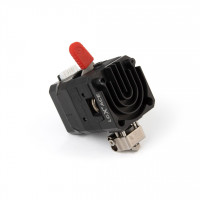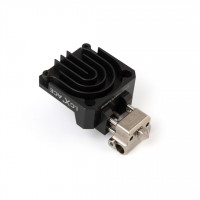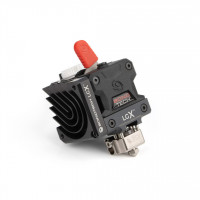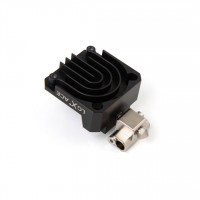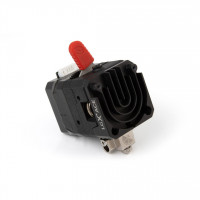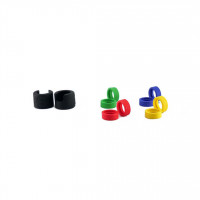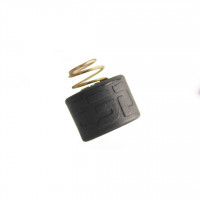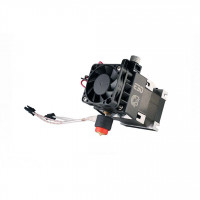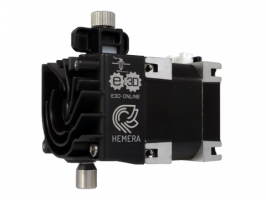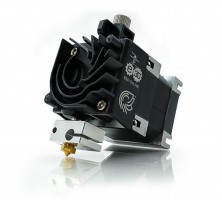
The extruder andhotend form the system that transports, melts and deposits the filament. They are the components that most influence print quality, maximum speed, the range of materials that can be used and the reliability of the machine.
An upgrade of the extruder orhotend is often the most cost-effective improvement for a 3D printer.
Extruder: the drive system
The extruder is the mechanism that grabs the filament and pushes it towardshotend. There are two main architectures.
Bowden
The extruder is mounted on the printer frame and the filament is pushed tohotend through a PTFE tube (tube Bowden). Advantages: the print head is lighter, allowing higher speeds and acceleration. Disadvantages: retraction is less responsive (the filament has to travel through the entire tube), and flexible materials (TPU) are more difficult to handle. Typical of Ender 3 and many Cartesian printers.
Direct Drive
The extruder is mounted directly on the printhead, a few centimetres fromhotend. Advantages: very responsive retraction, excellent handling of flexible materials, better flow control. Disadvantages: the head is heavier, limiting speed and acceleration (unless ultralight extruders are used). This is the standard for modern high-end printers (Bambu Lab, Prusa, Voron).
Hotendwhere filament becomes liquid
Thehotend is made up of several key elements: the heater block (heater block) which contains the heating cartridge and thermistor, theheatbreak which separates the hot zone from the cold zone, the heat sink (heatsink) which prevents the heat from flowing back to the solid filament, and the nozzle (nozzle) which determines the diameter of the extruded plastic filament.
Hotend with PTFE tube vs all-metal
In the hotend with PTFE tube, the filament is guided by a PTFE tube to the inside of theheatbreak. Easy to use, excellent for PLA and PETG, but limited to around 240 °C (beyond that, PTFE degrades releasing toxic fumes). In the all-metal hotend, theheatbreak is made entirely of metal (titanium or bimetallic stainless steel). They allow temperatures up to 300 °C and above, necessary for Nylon, PC, PEEK and composites. They require extra attention to retraction to avoid clogging.
Reference Brands
E3D
Pioneer of the open-source hotend. The V6 has been the reference standard for years, followed by Revo with its tool-free nozzle change system. The hotend E3D are compatible with most printers and are a safe upgrade.
Bondtech
Specialising in precision extruders. The Dual Drive system (LGX, LGX Lite, DDX) uses two opposing gears for smooth and powerful drive. The new INDX system with Dynamic Dual Drive represents the future of tool changing.
Phaetus
Hotend high-performance drives such as the Rapido and Dragon, designed for high flow rates and fast changes. The Rapido UHF can achieve flow rates of 75 mm³/s, ideal for fast printing.
Slice Engineering
Known for the Mosquito, an all-metal modular hotend with excellent thermal dissipation. The Copperhead line with bimetallic copper components offers the best thermal control available.
Nozzles: material and diameter
The nozzle is the consumable component ofhotend. Brass is the standard for PLA, PETG and ABS (excellent thermal conductivity, low cost, but wears out with abrasive filaments). Hardened steel is required for fibre-filled filaments (CF, GF). Plated copper or ruby offer the highest performance for specialised applications. The most common diameters are 0.4 mm (standard), 0.2 mm (fine detail), 0.6 mm (good speed/detail compromise) and 0.8 mm (fast, structural printing).
Extruders and hotend at DHM-online
At DHM-online you will find extruders and hotend from the leading brands: E3D (V6, Revo, Hemera), Bondtech (LGX, LGX Lite, DDX, CHT), Phaetus (Dragon, Rapido), Slice Engineering (Mosquito, Copperhead), as well as nozzles, heatbreak, heating blocks, cartridges and thermistors as spare parts.
The DHM technical team is available to advise you on the best upgrade for your printer.