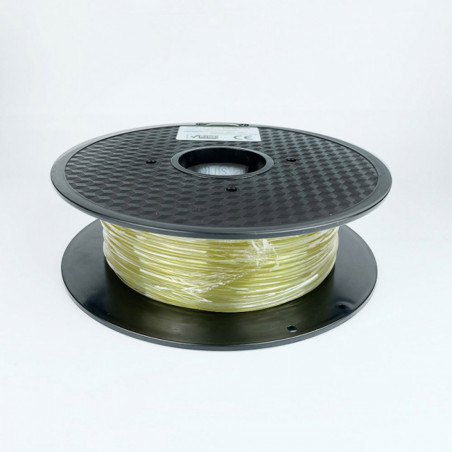
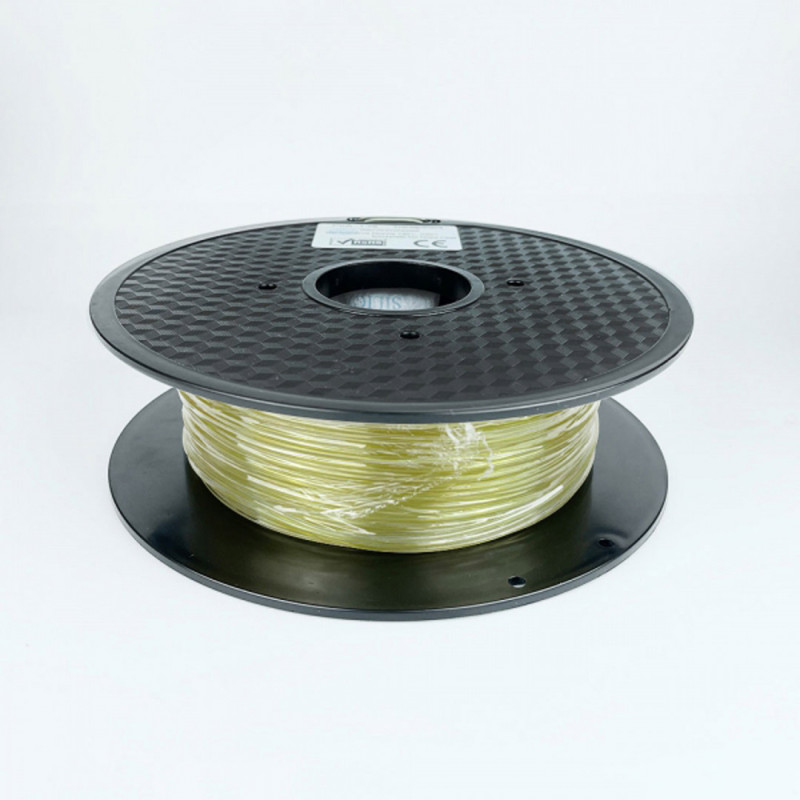
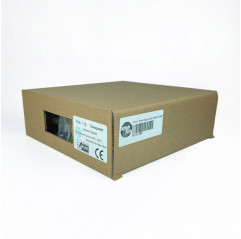
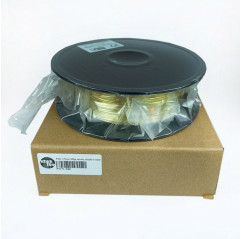
PVA filament from Azurefilm is a water-soluble support filament. It is very popular because it is printed at temperatures similar to PLA, and these make a good match.
A print with PVA filament appears transparent and slightly yellow. It is most commonly used in 3D printers with a dual print head. In fact, one head prints base material (e.g., PLA, PETG, TPU, Nylon), while the other prints PVA to provide support for all surfaces that have undercuts.
How does PVA work?
After printing the model with the PVA supports, you simply place it in warm water and within 12-24 hours, the PVA material dissolves completely. You then get the finished model without supports and requiring minimal post-processing.
What are the strengths of PVA Azurefilm 3D printing filament ?
PVA Azurefilm is characterized by several aspects:
- PVA Azurefilm is easy to print
- Usable as a printing substrate because it is soluble in water
- Ideal for Dual-Drive 3D printers : thanks to the dual extruder, both the build material and the support material (PVA) can be printed
- Being soluble, it leaves no residue after dissolution and makes post-processing easier
- Color shade: natural without additives
Note: It is recommended to dry the material before printing (at about 45 °C for 10 hours) to achieve a perfect printing effect.
What are the properties of PVA 3D printing filament Azurefilm?
The properties of PVA 3D printing filament from Azurefilm are:
- Difficulty of use: Low
- Shrinkage/deformation: minimal
- Soluble: yes, in water
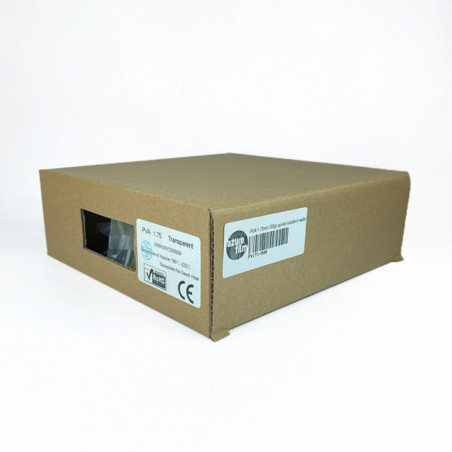
Package contains: 1 x 500g 1.75mm PVA filament spool for 3D printing Azurefilm