Discover all our ready-to-use configurators for semi-finished products according to your needs
Find out more



assistant_photo
Worldwide express shipping
Menu
- My DHM
- +Products
- +Mechanical components
- +Profiles structural and accessories
- +Hardware and Screws
- +Industrial material
- +Robotics and Automation
- Motor driver
- Relays and switches
- Power supplies
- Modules and card expansions
- Fans
- Parts for cards
- Control cards
- Arduino boards
- Integrated computers and development boards
- Spies and warning lights
- Duet 3D
- Arduino compatible
- Optoelectronics
- Passive components
- Thermal management
- Video surveillance
- Sensors
- Batteries and Chargers
- Semiconductors
- PCB Prototyping
- Motors
- Data storage and connectivity
- CNC Machines
- +Electrical equipment
- +Extruder group - 3D printing
- +Print bed - 3D print
- +Filaments and 3D Resins
- PLA
- Special PLA
- Loaded
- PETG
- Co-polyesters
- PP - Polypropylene
- Eraser
- PA - Polyamide
- ASA
- ABS
- Special ABS
- PC - Polycarbonate
- PVA and supports
- HIPS
- SKIN contact
- PEI - Polyetherimide
- PMMA
- PPSF & PSU - Polyphenylsulfone
- Accessories - filaments
- PELLETS
- Resins
- Brands Filaments and 3D Resins
- PEKK & PEEK
- PE - Polyethylene
- PVDF - Polyvinylidene fluoride
- ESD-Safe
- PACKS
- +3D printers
- +Tailor-made workings and kits
- Gift Cards
- CLEARANCE
- Manufacturers
- DHM online services
- New Products
- Prices Drop
- My Projects
- Blog
- Contact Us
- Help
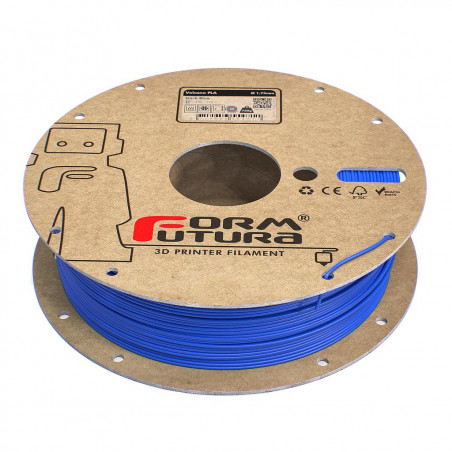
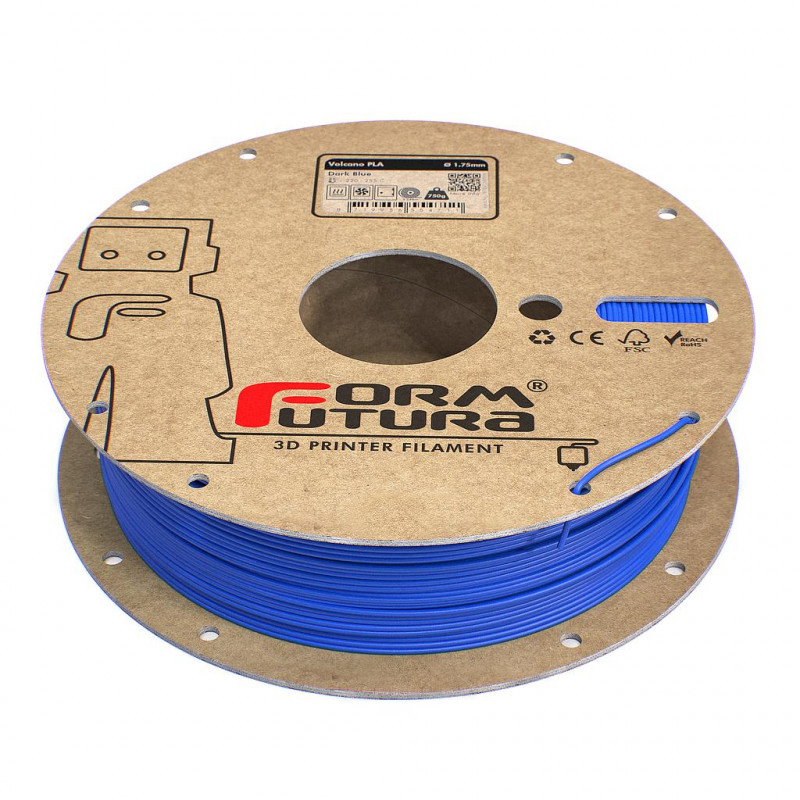
Volcano PLA - Dark Blue - Formfutura

19161066
€40.28
Added to your Project
Removed from your Project
VAT included
Shipping excluded
Immediate Availability
Price from €4.02
Dispatch in 24/48H
Volume discounts
| Quantity | Price |
|---|---|
| 2 | €38.27 |
- Product Details
- Description
Volcano P LA is an industrial-grade PLA 3D printing filament designed for high printing speeds, high heat resistance, high impact resistance and ABS-like mechanical properties.
Compatible with high speed - 150 mm/s
With high-speed 3D printing becoming increasingly popular due to the introduction of high-speed 3D printers, FormFutura is pleased to introduce a range of new and upgraded materials to its assortment. While these materials are suitable for conventional printers, they have been fully optimised for the new high-speed 3D printing technology.After annealing treatment, Volcano PLA resists heat up to 95 °C. It is an industrial-grade PLA filament designed for high printing speeds. Its mechanical properties are similar to ABS, with the added advantage of being biodegradable and easy to print. Volcano PLA offers high impact resistance and low shrinkage, making it the ideal PLA-based filament for industrial applications.Unique features
- High heat resistance: ≥ 95 °C after annealing
- Less than 0.3% shrinkage after annealing
- Approximately 8 times less shrinkage than competitive materials available on the market
- Designed for excellent dimensional accuracy before and after annealing
- Optimised for high printing speeds: > 120 mm/s
- High crystallinity immediately after extrusion, increasing rigidity and temperature resistance
- Excellent mechanical properties comparable to ABS
- Excellent interlayer adhesion layer
- Biodegradable
- Matt surface finish
General printing guidelines *
Nozzle diameter: ≥ 0.15 mm
Height layer: ≥ 0.06 mm Flow rate: ± 95 - 110 Print temperature: ± 230 - 265 °C*.
Print speed: High Shrinkage: Yes ± 5 mm Heated plate: ± 0 - 60 °C*.
Fan speed: 50-100%. Experience level: Beginner *) The above settings are intended as guidelines for finding optimal printing parameters. These ranges should work with most printers, but feel free to experiment outside these values if you feel it is suitable for your printer. There are many different types of printers, hot-end and offset, so it is extremely difficult to provide a universal setting that applies to all.*) The flow rate depends on the printing speed and the type of hotend used. For hotend all-metal, a lower flow rate is recommended, and for higher print speeds a higher flow rate is recommended.Annealing of Volcano PLA
Annealing is a secondary process in which a plastic part is heated up to half its melting temperature for a moderate period before being allowed to cool down to room temperature. In this way, the material relaxes, reducing internal stresses and improving dimensional stability, reducing distortions and defects, and improving the physical and thermal properties of the moulded and treated object.*) When using high-speed printing, the above settings may need to be adjusted accordingly.Step 1:Preheat a convection oven to 110 °C (half the melting temperature of Volcano PLA). We recommend using a thermometer to calibrate the exact temperature of the oven.Heating the oven to 110 °C is essential, as the Volcano PLA-printed object will crystallise quickly, minimising shrinkage (<0.3%), making Volcano PLA unbeatable in reducing post-annealing shrinkage.Step 2:When the oven has reached a stable temperature of 110 °C, quickly insert the printed object. Do not remove any media while placing it in the oven.We recommend placing the object on aluminium foil or another flat metal surface for even heat transmission.Small objects: ± 20 minutes (thin wall, medium infill)Large objects: ± 60 minutes (thick walls, medium/high infill)Step 3:At the end of the annealing time, switch off the oven and allow the object to cool to room temperature. Do not remove the object before complete cooling.Step 4:When the oven is completely cool, remove the object and remove any media. The object printed in Volcano PLA is now annealed and has all the thermal and mechanical properties indicated in the Technical Data Sheet (TDS).Filament length
ρ: 1.27 g/cc Spool 50 g Spool 0.5 kg Spool 2,3 kg Spool 4,5 kg Spool 8 Kg Ø 1.75 mm ± 16,4 m ± 246 m ± 753 m ± 1473 m ± 2619 m Ø 2,85 mm ± 6,2 m ± 93 m ± 284 m ± 555 m ± 987 m Package contains: 1 x Volcano PLA - Dark Blue - Formfutura
- Read more
For further information please contact us.
The item you receive may differ in some features from the one shown in the photo, depending on the production batch. Despite this, functionality is maintained.
- Attachments
- Questions(FAQs)
L'ASA è il materiale consigliato per l'uso esterno. A differenza dell'ABS, l'ASA è altamente resistente ai raggi UV, non ingiallisce e mantiene le sue proprietà meccaniche anche sotto l'esposizione diretta del sole e degli agenti atmosferici.
Il PETG è un materiale molto viscoso. Per ridurre lo stringing, è fondamentale calibrare correttamente la temperatura di stampa e la distanza di ritrazione. Inoltre, assicurati che il filamento sia asciutto, poiché l'umidità assorbita peggiora drasticamente questo fenomeno.
In generale è sconsigliato, poiché ogni resina ha tempi di esposizione e composizioni chimiche differenti. Mescolarle potrebbe portare a fallimenti di stampa o a una polimerizzazione incompleta del pezzo.
La resina liquida è considerata un rifiuto speciale. Non deve mai essere gettata negli scarichi domestici. È necessario polimerizzare i residui liquidi (esponendoli al sole o a lampade UV) fino a renderli solidi, dopodiché possono essere smaltiti seguendo le normative locali sui rifiuti plastici speciali.
5 Similar Products:


€40.28Price
Added to your Project
Removed from your Project

€40.28Price
Added to your Project
Removed from your Project

€40.28Price
Added to your Project
Removed from your Project

€40.28Price
Added to your Project
Removed from your Project
arrow_back
arrow_forward
- Images