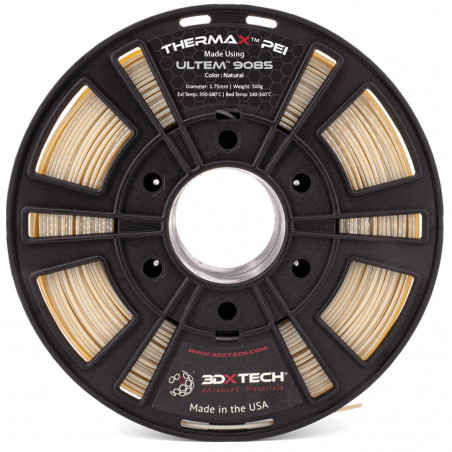
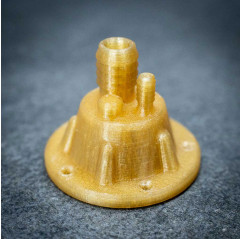
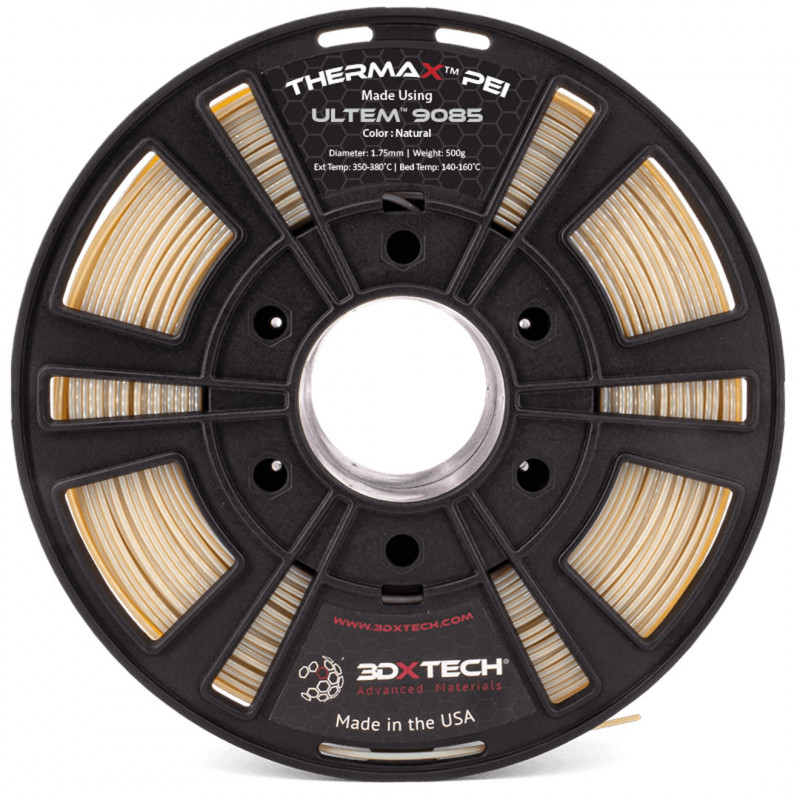
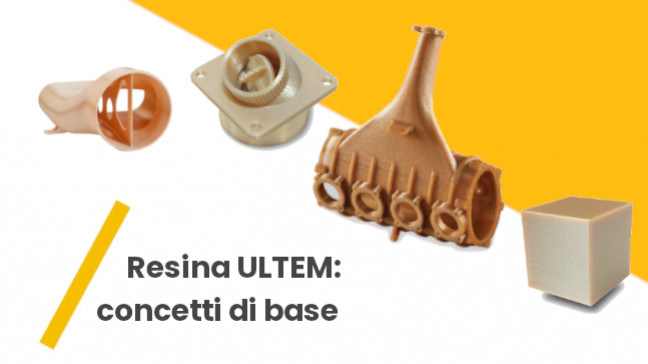
Package contains: 1 x THERMAX PEI MADE USING ULTEM 9085 - Natural / 1.75mm - 3DXTech
This high-performance 3D printing filament is made using Sabic's ULTEM 9085 PEI (polyether imide) resin. Filaments made from ULTEM 9085 resin offer the ability to create parts with excellent properties at high temperatures due to a high glass transition temperature (Tg) of 186°C. PEI is a high-performance amorphous polymer that combines excellent thermal properties, exceptional dimensional stability, inherent flame retardancy and good chemical resistance.
Benefits of PEI 9085 include:
High thermal properties, with a Tg of 186°C
Inherently flame resistant with low smoke evolution and low smoke toxicity
Long-term hydrolytic stability
Excellent dimensional stability, low sensitivity to thermal creep and a very low and uniform coefficient of thermal expansion create highly reproducible part-to-part dimensions
Exceptional strength and modulus, even at elevated temperatures
Good resistance to a wide range of chemicals, including automotive fluids, fully halogenated hydrocarbons, alcohols and aqueous solutions
Stable dielectric constant and dissipation factor over a wide range of temperatures and frequencies
Typical applications for ULTEM 9085 PEI:
Aerospace:
ULTEM 9085's excellent balance of flame retardant, low smoke emission and low smoke toxicity makes it an excellent candidate for aerospace and aviation applications. ULTEM 9085 meets FAR 25.853 and OSU 65/65 with low toxicity, smoke development and flame. Ultem resins are found in applications such as personal service units, oxygen panels and components, ventilation system components, connectors, cable trays, latches, hinges, food tray containers, door handles and interior trim parts.
Automotive and Transportation:
ULTEM resins provide automotive manufacturers with a high-performance, chemically resistant, thermally stable and cost-effective metal alternative that is strong enough to replace steel in some applications but light enough to replace aluminum in others. For applications such as transmission components, throttle bodies, ignition components, sensors and thermostat housings.
Electronics:
ULTEM resin can be an excellent material choice for today's demanding electrical applications including connectors, MCB components such as housings, shafts and levers, hard drive internals, FOUPs, BiTS, PCBs, MCCB internals, Plenum devices, LCD projector internals, fuel cell components and many other applications.
Filament specifications:
Diameter: 1.75 mm (+/- 0.05)
Recommended print settings:
Extruder: 350-380°C
Platen temperature: 140-160°C
Platen preparation: adhesive or poly tape is recommended
Other: no cooling fan with print speed of 16 mm/s as a starting point
Heated chamber: recommended, a chamber helps reduce warpage and improves layer adhesion
Media: The ThermaX HTS high temperature media is ideal for complex, high temperature materials such as this.
Drying instructions: 120°C for 4 hours.
Annealing of 3D printed parts:
If necessary, parts printed with ULTEM can be annealed in a hot air oven to reduce any printed stresses that may be present in the part. Printed stresses can occur in any plastic and can result in lower than expected mechanical properties. If this is an issue with your part, you can follow the simple 5-step up/down process for annealing ULTEM parts.
Step 1: Place molded parts in a cool oven at room temperature.
Step 2. Set the temperature to 250°F and allow to stabilize for 1 hour.
Step 3: After 1 hour at 250°F, increase the oven temperature to 300°F and allow 1 additional hour to stabilize.
Step 4: after 1 hour at 300°F, reduce heat to 200°F and allow to stabilize for 30 minutes.
Step 5: After 30 minutes, turn off the oven and allow the molded parts to return to room temperature inside the oven while it cools.
ULTEM? is a registered trademark of Sabic Innovative Plastics.
3DXTECH manufactures this filament using ULTEM? 9085 PEI RESIN.