Worldwide express shipping

Volume discounts
| Quantity | Price |
|---|---|
| 2 | €17.03 |
Data sheet
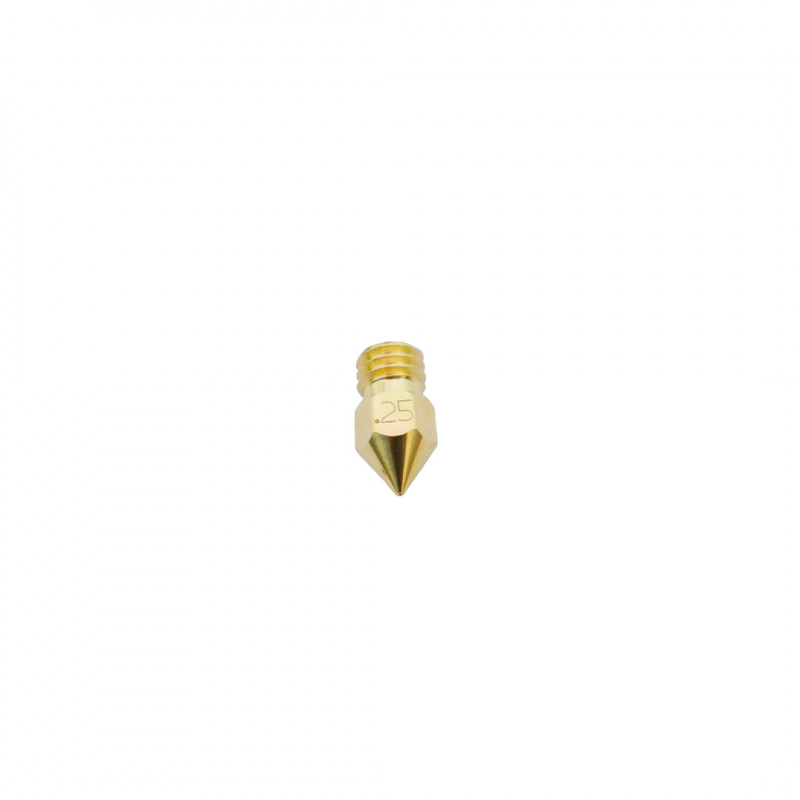
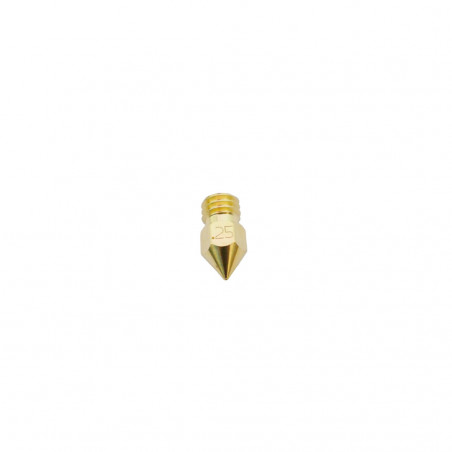
E3D's MK8 brass nozzles have optimal thermal properties for everyday prints and provide uniform layers for standard nonabrasive applications. You can use nozzles with small exit holes for precise details or nozzles with larger exit holes for more consistent and durable prints.
E3D's MK8 nozzles use the same proven internal geometry as the V6 and Revo range of nozzles. This prevents back pressure problems.
Compatibility
The full list of compatible printers is available here:
https://e3d-online.zendesk.com/hc/en-us/articles/6001996167197-MK8-Nozzle-compatibility-list
Key Features.
Maximum temperature: 300°C
Material: brass
Filament diameter: 1.75
Thread: M6x1
For technical specifications please visit the wiki dedicated to E3D products: https://e3d-online.zendesk.com/hc/en-us Here you can find technical details and installation examples. To share opinions and questions, including technical ones, you can consult the dedicated forum: https://forum.e3d-online.com/
The item you will receive may differ in some features from the one depicted in the photo, depending on the production batch. Despite this, functionality is maintained.
L'estrusore Single Drive utilizza un solo ingranaggio motorizzato e un cuscinetto a pressione. Il sistema Dual Drive utilizza due ingranaggi controrotanti che afferrano il filamento da entrambi i lati, garantendo una forza di spinta doppia e riducendo drasticamente lo slittamento, specialmente con filamenti tecnici o velocità elevate.
L'ugello va sostituito quando si notano problemi di stampa, specialmente superficiali, o se il diametro del foro si è allargato a causa dell'usura (comune con materiali abrasivi). Un ugello in ottone usato con fibra di carbonio può rovinarsi in poche ore di stampa, mentre uno in acciaio temprato può durare mesi.
Il rumore di scatto indica che il motore non riesce a spingere il filamento. Le cause, tra le altre, possono essere un ugello parzialmente ostruito, una temperatura di stampa troppo bassa, o una velocità di estrusione eccessiva per le capacità termiche del tuo hotend, un meccanismo non adeguato al tipo di filamento utilizzato.