Please note that our offices will be closed from May 29th to June 2nd. Orders placed after 12:00 PM on Thursday, May 28th will be processed starting Wednesday, June 3rd.
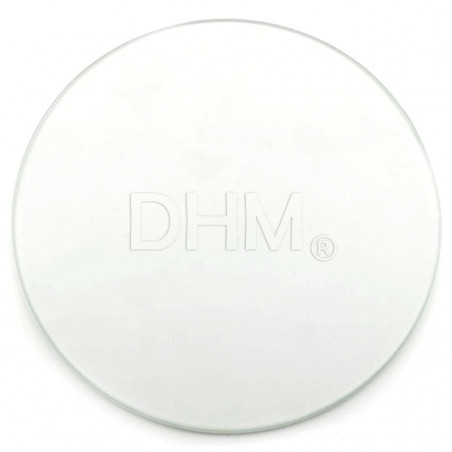
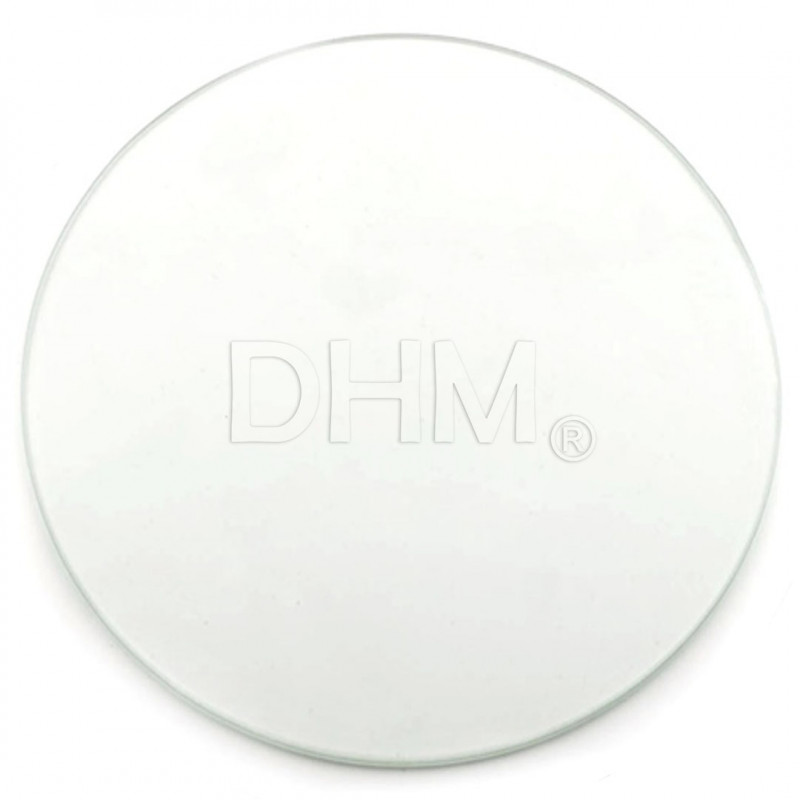
The package contains: 1 x High temperature glass Ø37 cm - thickness 3 mm
High-temperature glass perfect for use in conjunction with the hot plate for 3d printers such as Prusa, Mendel, or others.
It has a thickness of 3 mm and allows you to take advantage of a printing area of Ø 37 cm. It is also characterized by chamfered profiles to prevent those who handle it to get injuries. Tested at 120 ° C on one of our printers, it has proven to be a viable solution for printing PLA and ABS (the latter with the use of lacquer as a fixative).
Thanks to this glass the heated plate will always remain in perfect condition and it will not be necessary to cover it with kapton tape or other. After use it can be washed with soap and warm water to remove any residue of printed material and lacquer used as a fixative. To fix it to the plate you can use the clips of various sizes depending on your needs.
We also provide custom sizes.
It 'an object to be handled with care to avoid damage and possible injury from cutting.
ATTENTION!!! The measures may not be accurate to the mm.
The item you will receive may differ in some features from the one represented in the photo, depending on the production batch. Despite this, the functionality is maintained.
Qual è la differenza tra una piastra in alluminio normale e una rettificata 5083?
La piastra normale può presentare curvature invisibili all'occhio ma enormi per l'ugello di una stampante 3D. La piastra 5083 rettificata è lavorata meccanicamente per essere perfettamente piana e distesa termicamente, il che significa che non si "imbarcherà" mai quando la riscaldi a 80-100°C.
Posso incollare un tappetino riscaldante direttamente sulla piastra magnetica?
No, il tappetino riscaldante deve essere applicato sulla parte inferiore della piastra rigida (alluminio). La superficie magnetica va applicata sulla parte superiore. Il calore passerà attraverso l'alluminio e la base magnetica per scaldare la superficie in PEI o acciaio.
Come si pulisce correttamente una superficie in PEI?
Per mantenere l'adesione al massimo, è sufficiente pulire la superficie con alcool isopropilico (IPA) tra una stampa e l'altra. Se l'adesione cala drasticamente dopo molti utilizzi, un lavaggio con acqua tiepida e sapone neutro per piatti aiuterà a rimuovere i residui grassi delle dita.
È necessario isolare il piano di stampa sotto il riscaldatore?
Non è obbligatorio, ma è caldamente consigliato. L'isolamento riduce i tempi di riscaldamento del 30-50% e mantiene la temperatura molto più stabile, evitando che il calore residuo interferisca con il funzionamento dei sensori o dei motori situati sotto il piano.