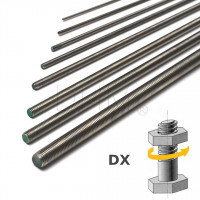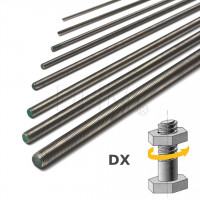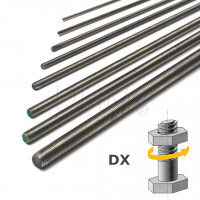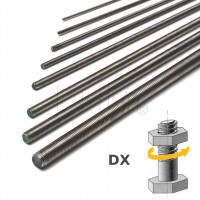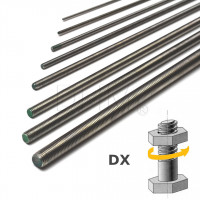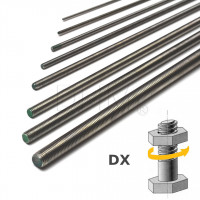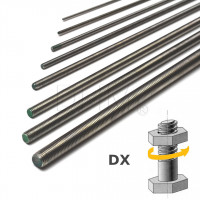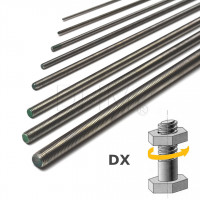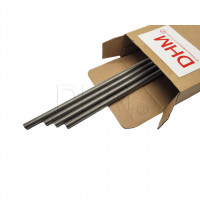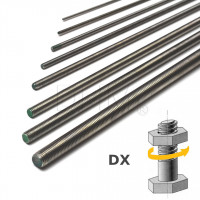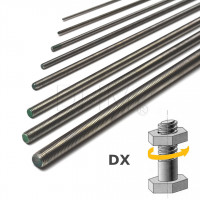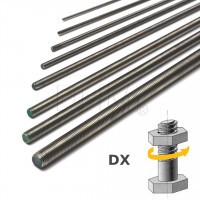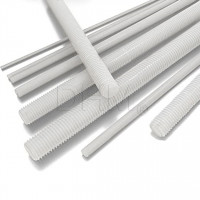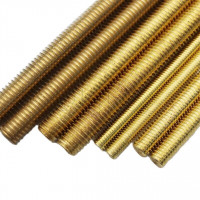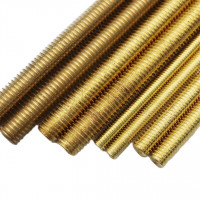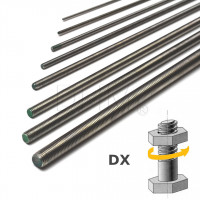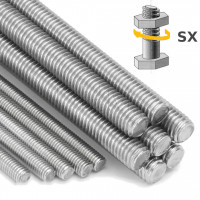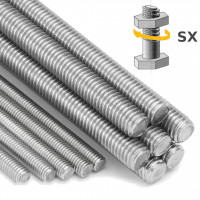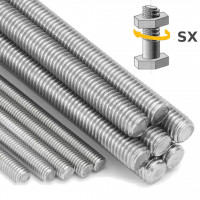
The threaded rod is a fastener that is as simple as it is versatile: a fully threaded cylindrical rod that can be cut to length and used as a tie rod, spacer, pivot, structural support or adjustment axis. In this guide we look at how to choose the correct material and strength class according to the application.
Available materials
Galvanised steel
The most common and cost-effective material. Galvanising protects against corrosion in indoor and moderately humid environments. Available in strength classes 4.8, 8.8 and higher. It is the standard for light construction, metal structures, plant engineering and general mechanical applications.
Stainless steel A2 (AISI 304)
Corrosion resistant in humid environments and in contact with fresh water. Amagnetic. Equivalent strength class 70 (tensile strength 700 MPa). Suitable for outdoor, food, chemical and moderate marine environments.
Stainless steel A4 (AISI 316)
Corrosion resistance higher than A2, especially in saline and chemically aggressive environments. Equivalent strength class 70-80. The obvious choice for marine, chemical and chloride environment applications.
Resistance classes
|
Class |
Breaking load |
Yield strength |
Typical use |
|
4.8 |
400 MPa |
320 MPa |
Light fixings, spacers |
|
8.8 |
800 MPa |
640 MPa |
Structures, tie rods, mechanics |
|
10.9 |
1000 MPa |
900 MPa |
High strength, high preload |
|
12.9 |
1200 MPa |
1080 MPa |
Maximum mechanical performance |
|
A2-70 |
700 MPa |
450 MPa |
Inox, general purpose |
|
A4-80 |
800 MPa |
600 MPa |
Inox, aggressive environments |
Most common sizes
The most commonly used threaded rods in mechanical engineering and 3D printing are M6 (light tie-rods, spacers), M8 (the all-rounder for structures and fasteners), M10 and M12 (structures and medium loads), M16 and M20 (heavy loads, construction). Standard lengths are 1 metre and 2 metres, but cut-to-size is available at DHM-online.
Typical applications
Threaded rods find application in many different contexts: tie rods and bracing for aluminium profile structures, spacers with nuts for stacking components at a precise distance, adjustment axes with adjustment nuts for fine positioning, through-fixing through walls and panels, Z-axis of 3D printers (especially older generations with M5 or M8 rods), and temporary structures and prototypes.
Threaded rods at DHM-online
At DHM-online you will find threaded bars in galvanised steel and stainless steel in sizes M4 to M20, with a cut-to-length service. Also available: hex nuts, self-locking nuts, flat washers and growers, and everything you need to make complete joints.
Frequently asked questions about threaded rods: guide to selection and use
1. What is the difference between a 4.8 and an 8.8 threaded rod?
The difference lies in the mechanical properties of the material. A class 8.8 bar (high-strength steel) has an ultimate tensile strength of 800 MPa, twice that of class 4.8, which is considered mild steel. For structural applications, tension rods or mechanical fasteners on CNC machines and 3D printers, it is essential to use at least class 8.8 to ensure the safety and stability of the system.
2. When to choose A2 stainless steel threaded rod over A4?
A2 stainless steel (AISI 304) is the ideal choice for corrosion resistance in wet environments, outdoors or in the food industry. However, if the application is in a marine environment (contact with brackish water) or in the presence of aggressive chemicals and chlorides, it is mandatory to switch to A4 stainless steel (AISI 316), which offers superior protection against crevice and salt corrosion due to the addition of molybdenum.
3. Can a metric threaded rod be used for the Z-axis of a 3D printer?
Although M5 or M8 bars were used in the first generations of hobbyist 3D printers, today this solution is considered outdated by trapezoidal screws. However, if a threaded bar is used for linear motion, it is essential to ensure that it is perfectly straight and couple it with quality nuts to reduce backlash and premature wear of the triangular threads, which are not natively designed for motion transmission.
4. How to correctly cut and finish a threaded rod?
Cutting can be done with a hacksaw or a mitre saw, but the key to not damaging the thread is to screw in a hexagonal nut before cutting. Once the bar has been cut, the end of the bar is ground to create a small invitation; by unscrewing the nut, it will act as a die, restoring the crest of the thread and allowing easy insertion of subsequent nuts. At DHM-online you can directly request a professional cut-to-length service to receive ready-to-use bars.
5. What are the advantages of galvanised steel in threaded bars?
Galvanised steel represents the best compromise between cost and performance for all applications indoors or in low humidity environments. The zinc layer protects the steel core from surface oxidation (rust) and allows it to maintain excellent structural integrity over time. It is the standard material for the construction of frames, aluminium profile supports and general mechanical prototyping.