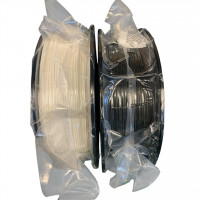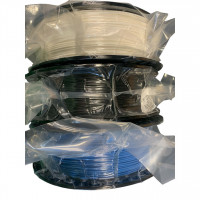
PLA and PETG are the two most widely used filaments in FDM 3D printing, and for good reason: both are relatively easy to print, widely available and suitable for a wide range of applications. But the differences between the two are significant and the wrong choice can compromise the outcome of your project.
In this comparison, we look in detail at the properties of both materials, the optimal printing conditions and the ideal applications for each.
Comparison table
|
Properties |
PLA |
PETG |
|
Extruder temp. |
190-220°C |
220-250°C |
|
Platen temperature |
20-60°C |
70-85°C |
|
Heated plate |
Optional |
Recommended |
|
Closed chamber |
Not required |
Not required |
|
Thermal resistance |
~60°C |
~80°C |
|
Rigidity |
High |
Medium-high |
|
Flexibility |
Low (brittle) |
Good (ductile) |
|
Impact resistance |
Low |
Good |
|
Chemical resistance |
Limited |
Good |
|
UV resistance |
Poor |
Fair |
|
Warping |
Minimal |
Low |
|
Stringing |
Low |
Medium-high |
|
Surface quality |
Excellent |
Good |
|
Variety of colours/finishes |
Huge |
Wide |
|
Post-processing |
Easy |
More difficult |
|
Biodegradable |
Yes |
No |
|
Odour in print |
Hardly any |
Light |
PLA: when to choose it
PLA is the ideal choice when the priority is aesthetic quality, ease of printing and colour variety. It is perfect for presentation prototypes, architectural models, action figures, gadgets, signs and any object that will not be exposed to significant heat or mechanical stress. It is also the recommended filament for beginners in 3D printing due to its tolerance to set-up errors.
PETG: when to choose it
PETG comes into play when you need mechanical and thermal performance superior to PLA without the complexity of ABS. It is ideal for functional parts, mechanical components, electronics covers, containers, parts exposed outdoors or in contact with liquids, and 3D printer components. Its combination of strength, flexibility and durability makes it the material of choice for semi-structural parts.
Printing recommendations for PLA
100% cooling fan for best surface quality. Moderate speed (40-60 mm/s) for fine details. Plate at 50-60°C with glue stick to improve adhesion. Standard retraction (4-6 mm for Bowden, 1-2 mm for Direct Drive). PLA is insensitive to ambient temperature: it can be printed without a closed chamber even in cool environments.
Printing tips for PETG
Slightly increase the Z-distance of the first layer with respect to PLA to prevent the material from adhering too much to the plate. Fan at about 50% (too much fan can cause delamination). Speed of the first layer reduced (20-30 mm/s). To reduce stringing: increase retraction speed, reduce temperature by 5°C, activate wipe and coasting in the slicer. PEI or glass plate with glue stick.
Can they coexist in the same project?
Absolutely yes! Many makers use PLA for initial prototypes and quick iterations, then switch to PETG for the final functional version. In multi-material prints, PLA and PVA are the ideal combination for soluble substrates, while PETG matches better with BVOH substrates.
PLA and PETG at DHM-online
At DHM-online you will find a wide selection of PLA and PETG filaments from the best manufacturers: Formfutura, AzureFilm, ColorFabb, TreeD Filaments, Bambu Lab and many others.
Use the filters by material, colour and brand to find the perfect filament for your project.