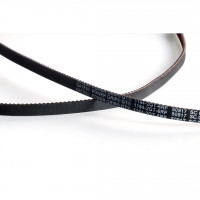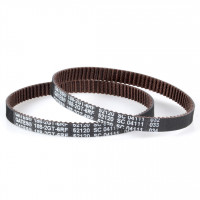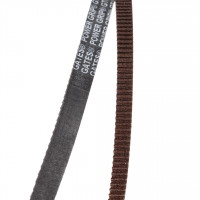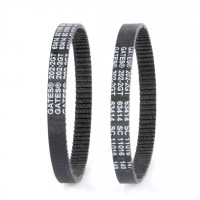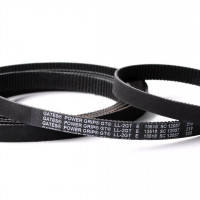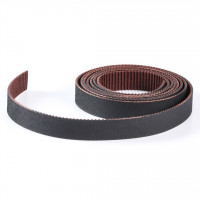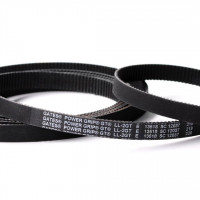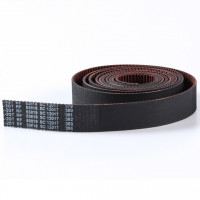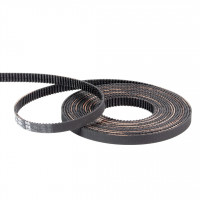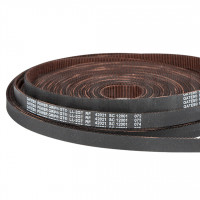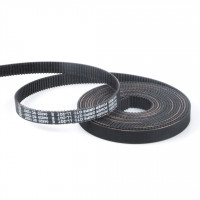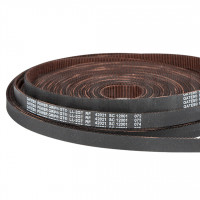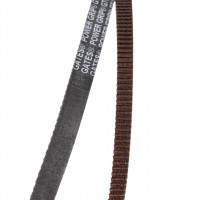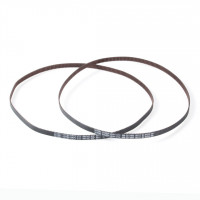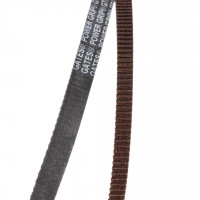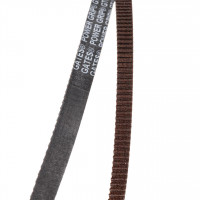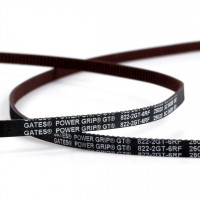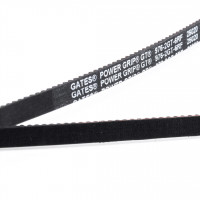
GT2 belts are the most popular motion transmission system for FDM 3D printers. Their precision, smoothness and lack of backlash make them ideal for converting the rotary motion of the motors stepper into the linear motion of the axes. But not all belts are the same: material, width, tension and quality of the pulleys directly influence print quality.
What is GT2 Profile
GT stands for Gates Tooth, a curved tooth profile developed by Gates Corporation. Unlike older trapezoidal profiles (such as T2.5 or MXL), the GT2 profile has rounded teeth that distribute the load more evenly, reducing backlash and wear. The number indicates the pitch: GT2 means 2 mm pitch, i.e. the teeth are spaced 2 mm apart.
Available widths
GT2 3D printing belts are mainly available in two widths: 6 mm, the standard for most 3D printers (Ender, Prusa MK4, Bambu Lab), sufficient for light and medium loads; and 9 mm, used in high-performance printers (Voron 2.4, RatRig) and lightweight CNCs, offering greater tensile strength and better load distribution.
Internal reinforcement materials
Glass fibre
The standard reinforcement found in most low-cost belts. Offers good strength and flexibility at a low cost. Suitable for most Cartesian 3D printers and moderate speeds.
Steel core
Steel core belts offer almost zero elongation under load, ensuring maximum precision and repeatability. They are the recommended choice for high-speed CoreXY printers, where even minimal belt elongation results in visible artefacts on the print (ringing/ghosting).
Kevlar
Some premium belts use Kevlar reinforcement, which offers excellent tensile strength with low weight. Less common but appreciated in high-end builds.
Pulleys: don't underestimate them
Timing pulleys convert motor rotation into belt movement. The key parameters are the number of teeth (16T and 20T are the most common; 20T offers slightly less resolution but less stress on the belt), the hole diameter (5 mm for NEMA 17), and the material (aluminium is standard, steel for heavy loads). Idler pulleys (idler) guide the belt at the return points and must have quality bearings to reduce friction and noise.
Belt tension: the critical factor
A belt that is too loose causes backlash, inaccuracy and printing artefacts (ringing). A belt that is too tight increases wear on the motor bearings and can deform the axle. The correct tension is achieved when the belt, pressed to the centre of the stroke, flexes about 1-2 mm. Some advanced firmware (Klipper, RepRapFirmware) offer tools to measure the resonance frequency of the belt and check the optimum tension.
Installation tips
Cut the belt with sharp scissors or a box cutter to obtain a clean end. Check that the belt teeth mesh perfectly with the pulley teeth. Use grub screws to secure the pulleys to the motor shafts. Check the alignment between the motor pulley and idler pulley: misalignment causes lateral belt wear. Install adjustable belt tensioners to facilitate future adjustments.
Belts and pulleys at DHM-online
At DHM-online you will find 6 mm and 9 mm GT2 belts by the metre or in pre-assembled cuts, with glass fibre and steel reinforcement. Also available: 16T and 20T toothed pulleys, idler pulleys with and without teeth, belt tensioners, fastening beads and complete kits for major projects.
Browse the Transmission and Belts section to find everything you need.