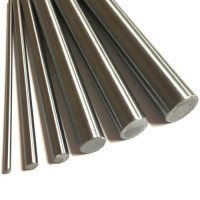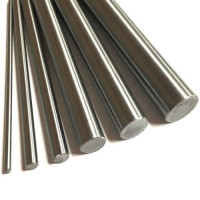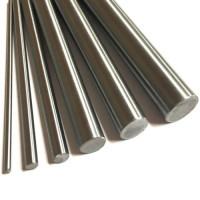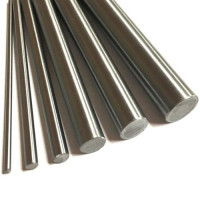
Plain shafts are fundamental components of linear motion: linear bushings, bearings and housings slide on them. The choice of the right shaft - in terms of material, surface finish and dimensional tolerance - directly influences the precision, smooth running and service life of the entire system. At DHM-online you will find four types of shafts to meet every need.
The four types
Ground shaft
The ground shaft is machined in a grinding process to achieve an extremely smooth surface and close dimensional tolerance. It is made of mild, unhardened steel and offers the best value for money for low load applications. Ideal for prototypes, entry-level 3D printers and polymer bushing systems (such as Igus). Typical tolerance: h6.
Chrome-plated shaft
The chrome-plated shaft has a hard chrome-coated surface that improves corrosion resistance and reduces friction with linear bushings. The base steel is not hardened. Good choice for wet environments or when a harder surface is needed than the plain ground shaft, without the cost of hardening. Typical tolerance: h6.
Hardened shaft
The hardened shaft undergoes a heat treatment that increases the surface hardness to 60-62 HRC. This makes it extremely wear resistant and suitable for linear ball bearing systems where surface quality is critical. It is the standard choice for CNC and mid- to high-end 3D printers. Typical tolerance: g6 (narrower than h6).
Hardened chrome-plated shaft
Combines hardening treatment with hard chrome coating: maximum hardness, minimum friction, maximum corrosion resistance. It is the top choice for professional linear systems, precision CNC and industrial environments. Typical tolerance: g6.
Comparison table
|
Type |
Hardness |
Tolerance |
Anticorrosion |
|
Ground |
Low (mild steel) |
h6 |
No |
|
Chrome-plated |
Medium (surface chrome) |
h6 |
Yes |
|
Hardened |
High (60-62 HRC) |
g6 |
No |
|
Hardened Chrome |
High + chrome |
g6 |
Yes |
Most common sizes
The most common sizes used in 3D printing and hobbyist CNCs are 6 mm (small, compact printers), 8 mm (the standard for 3D printers such as Prusa i3, Ender), 10 mm (light CNCs), 12 mm (medium CNCs, large format printers) and 16-20 mm (medium CNCs). Standard lengths start at 100 mm and go up to 1000 mm and more. A cut-to-size service is also available at DHM-online.
How to choose
For a hobbyist 3D printer with polymer bushings, a ground or chrome-plated shaft is sufficient. For a 3D printer with linear ball bushings (LM8UU), at least a hardened shaft is needed so as not to wear out the balls. For a CNC that must guarantee precision over time, a hardened chrome-plated shaft is the optimal choice. For wet or corrosive environments, chrome plating is indispensable.
Shafts at DHM-online
At DHM-online you will find all four shaft types in sizes from 3 to 35 mm, in standard lengths and cut to length. In the Linear Motion section you will also find shaft supports (SK, SHF), locking rings and compatible linear bushings. The DHM technical team is available to help you dimension the complete linear system.
FAQ: Linear Motion Shaft Selection Guide
1. What is the difference between h6 and g6 tolerance in linear shafts?
The difference lies in the diameter accuracy. Tolerance h6 is the standard for ground and chrome-plated shafts, suitable for precise fits but with a minimum of play. The g6 tolerance, which is typical of hardened shafts, is even tighter and more precise: it is essential when using professional recirculating ball bearings, as it guarantees smooth, quiet running without mechanical vibration.
2. Why do recirculating ball bearings need a hardened shaft?
The steel balls inside the linear bushings (such as the popular LM8UU) exert a very high point pressure. If the shaft is not hardened (60-62 HRC), the balls will dig grooves in the surface of the mild steel, compromising accuracy and destroying the bearing in a short time. For use with balls, a hardened shaft is a compulsory choice to ensure system life.
3. When is it better to choose a chrome-plated shaft over a ground one?
The chrome-plated shaft is preferable when the system operates in humid environments or where a lower coefficient of friction is required. The hard chrome coating not only protects the steel from oxidation and rust, but also provides a more 'slippery' surface that reduces wear on bushings, especially those made of polymer or bronze.
4. What shaft diameter to choose for a 3D or CNC printer?
The choice of diameter depends on the length of the shaft and the load. For average desktop 3D printers, the standard is an 8 mm shaft. If the shaft length exceeds 400-500 mm, it is advisable to switch to 10 mm or 12 mm diameters to avoid bending (the so-called 'arc effect'). For CNC machines that are subject to cutting forces, we usually start with a minimum of 16 mm or 20 mm.
5. Can I request linear shafts cut to size at DHM-online?
Certainly. At DHM-online, a professional cut-to-size service is available for all types of shafts (ground, hardened and chrome-plated). You can order bars of the exact length you need for your project, eliminating the need for complex in-house machining, which is often difficult on hard materials such as hardened steel.