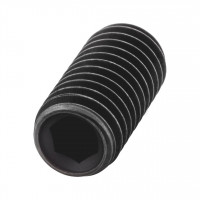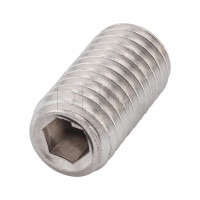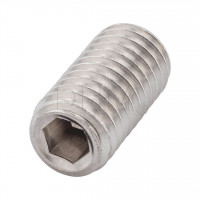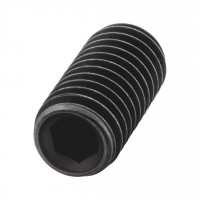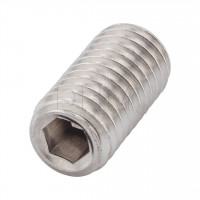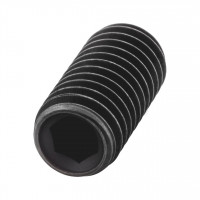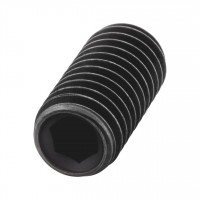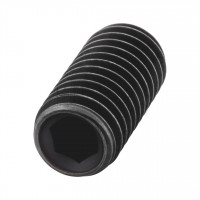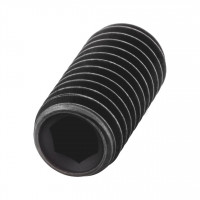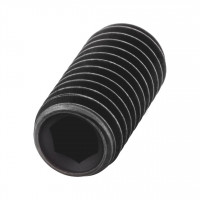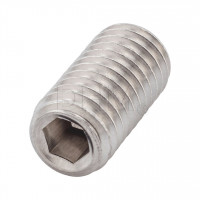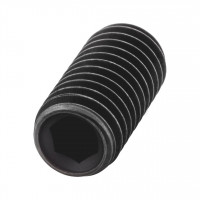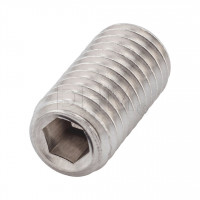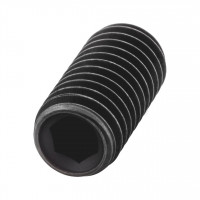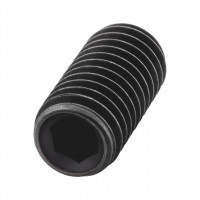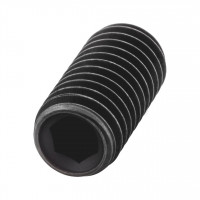
Screws, also known as set screws in English, are key fastening elements in precision mechanics, 3D printing, robotics and automation. Despite their small size, they perform critical functions such as clamping pulleys, couplings and components on rotating shafts.
In this guide we look at all the types available and how to choose the right one.
What is a setscrew?
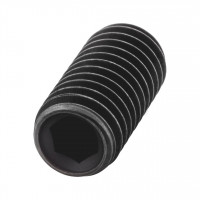
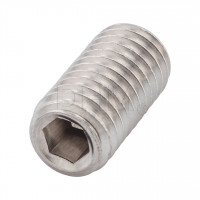
A setscrew is a fully threaded screw with no protruding head. It is screwed until it is completely embedded in the threaded hole of the workpiece, exerting pressure on the contact surface. The operating seat is typically a hexagon socket (Allen key) at the top.
Bit types
Flat point - DIN 913
The flat point exerts pressure distributed over a relatively large surface area. It is the most common and versatile type. Ideal when you want to secure a component without damaging the contact surface, e.g. for clamping a pulley on a smooth shaft with the possibility of position adjustment.
Cup point - DIN 916
The cup point has a sharp edge that 'bites' into the shaft surface, creating an indentation and preventing sliding. It offers the best clamping of all types and is the most commonly used in torque transmission applications. Ideal for securing pulleys, couplings and gears on shafts where secure locking is required even under vibration.
Conical tip (cone point) - DIN 914
The cone point penetrates an existing hole or comic indentation in the contact surface, ensuring precise and repeatable centring. It is the ideal choice when it is necessary to position a component in a precise and repeatable position, such as in the case of fine adjustments or mechanical alignments.
Dog point - DIN 915
The dog point has a cylindrical end that fits into a corresponding seat, functioning as a positioning pin. It provides positive locking without the possibility of slipping. Ideal as a stop pin, for mechanical guides and for fasteners requiring precise interaction with a seat or keyway.
Materials and strength classes
Grains are available in different materials. Heat-treated carbon steel (class 14.9 or 45H) is the standard for most mechanical applications. Stainless steel (A2/AISI 304) offers corrosion resistance for wet or chemically aggressive environments. Brass is used when you want to avoid damaging soft surfaces.
Common sizes
Screws are available in metric threads from M2 to M24, with the most common sizes in precision mechanics and 3D printing being M3, M4, M5 and M6. Lengths typically range from 3 mm to 50 mm and more. For the most common applications (GT2 pulley clamping, flexible couplings, shaft supports), M3 and M4 beads with a length of 4-8 mm are the most commonly used.
Practical tips
To get the most out of bolting with grub screws, consider these tips. Create a flat impression on the shaft with a file if you use flat-tipped grub screws: the contact will be more stable. Use medium threadlocker (such as Loctite 243) on applications subject to vibration. Do not over-tighten: small beads break easily. For 3D printing, cup point grub screws are the standard choice for pulleys, couplings and shaft supports. Always keep a stock of the most commonly used sizes (M3x4, M3x5, M4x5, M5x8).
Grains at DHM-online
At DHM-online you will find a large selection of grains in all tip types (flat, cup, conical, pin), in sizes M2 to M24, in burnished steel and stainless steel. All products are available in single quantities or in packs.
Browse the Screws → Grains section of the catalogue to find exactly what you need.