What cut to size means
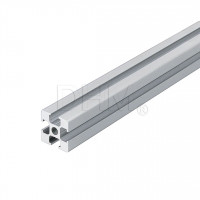
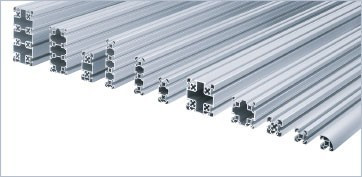
Cut to size means the supplier delivers aluminium extrusion bars already sectioned to the lengths required by the customer, ready for assembly. Cutting is typically done with high-speed CNC circular saws fitted with carbide blades, ensuring perpendicularity and surface finish suitable for assembly.
Standard cutting vs precision cutting
Standard commercial cutting has a typical tolerance of ±0.5 mm on length and perpendicularity around ±0.5°. It is adequate for most automation, bench and frame applications. Precision cutting (±0.1 mm) is needed only for tight assemblies and comes with longer lead time and higher cost.
Typical tolerances
|
Parameter |
Standard |
High precision |
Notes |
|
Length |
±0.5 mm |
±0.1 mm |
Referred to nominal dimension |
|
Perpendicularity |
±0.5° |
±0.1° |
Cut inclination |
|
Deburring |
Removed |
Chamfered |
Standard: sharp edges removed |
|
End face flatness |
Not guaranteed |
On request |
For precise fits |
A ±0.5 mm tolerance on a 1000 mm bar is acceptable in 95% of automation applications. If two bars must align perfectly in a rigid frame, plan for adjustment through brackets or request precision cutting.
Available finishes
Anodising
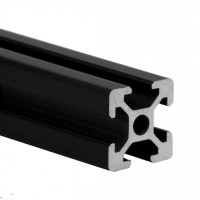
Almost all profiles on the market are anodised. Natural anodising (silver) protects from corrosion and gives a uniform finish. Black anodising has the same mechanical properties and adds aesthetic and anti-reflective qualities, useful in machine vision applications.
Deburring and chamfering
The market standard is removal of cutting burrs, not chamfering of edges. For applications with frequent manual handling or aesthetic requirements, request a 45° chamfer.
Additional machining
• End drilling for internal connection screws
• End tapping (M5, M6, M8 depending on series)
• Additional slot milling or slots
• Miter cuts (45° or custom angle)
Typical lead time
Lead time depends on quantity and stock availability. Indicatively, for stocked items, cutting and shipping happen in 2-5 business days. For special profiles or non-stocked anodising, lead time extends to 10-20 days.
How to prepare your order correctly
Pre-order checklist
• Exact profile code and series (check the slot)
• Length in millimetres, not centimetres or inches
• Quantity per each distinct length
• Finish: natural or black anodised
• Required tolerance (standard or precision)
• Additional machining required
• Delivery address and technical contact
Most common mistakes
• Specifying useful length while ignoring connector bracket thickness
• Not specifying slot orientation on asymmetric profiles
• Mixing up series with the same outer dimensions
• Ordering multiple lengths without considering commercial bar offcuts
• Forgetting the finish: ordering silver when the project is in black
Case study: tolerance mistake in an automated cell
A cell builder designed a slot 8 frame with ten vertical uprights fixed to a single upper plate. The order specified 1500 mm length without recalling tolerance. Delivered bars showed real deviations between +0.3 and -0.4 mm. During assembly, the upper plate was not coplanar and required manual shimming. The issue would have been avoided by specifying ±0.1 mm tolerance in the order or by planning adjustable brackets in the design.
Advantages of online cutting via configurator
• Immediate quote without manual requests
• Cut to the millimetre without minimum order
• Order history for quick re-ordering of repeated batches
• Reduced transcription errors vs email or phone
• BOM export in PDF or CSV for purchasing
FAQ
What is the standard tolerance for aluminium profile cutting?
The commercial standard tolerance is ±0.5 mm on length, sufficient for most automation and frame applications. For precise fits, ±0.1 mm is available on request.
Can I order lengths under 100 mm?
Yes, online configurators allow cuts to the millimetre starting from the minimum length the CNC saw can handle, typically 30-50 mm. Very small lengths may have a relatively high unit cost.
Does anodising get damaged at the cut?
Yes, cutting exposes bare aluminium in the section area. The cut surface is not anodised and should be protected with end caps or post-cutting anodising if the end remains exposed in a corrosive environment.
Can I request threaded holes directly in the cutting order?
Yes, advanced configurators allow end drilling and tapping (typically M5, M6, M8) as additional machining at cutting time.
Are miter cuts supported?
Yes, most CNC cutting services support miter cuts at 45° or custom angles. Verify the supported angles and tolerances in the configurator.
Conclusion
A well-prepared cutting order reduces lead time, avoids rework in the workshop and ensures clean assemblies. Using an online configurator standardises specifications and reduces the typical errors of manual communication with the supplier.