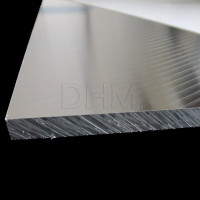
What 5083 aluminium is
5083 is an aluminium-magnesium (Al-Mg) alloy with about 4.5% magnesium. It belongs to the 5000 series and is characterised by high corrosion resistance, excellent weldability and dimensional stability over time. It is not a heat-treatable alloy: its mechanical properties come from composition and work hardening.
Key technical properties
• Tensile strength typically 270-345 MPa depending on temper
• Very high corrosion resistance, including marine environments
• Long-term dimensional stability after stress relief
• Good machinability in milling
• Good weldability with TIG/MIG using AlMg filler
Why grind the plate
Standard rolled aluminium plate, even in premium alloys, does not guarantee enough flatness for precision use. During rolling, the material accumulates internal stresses that release over time or under load, causing deformation. Mechanical grinding („cast tooling plate“ production) removes material from both faces after stress relief, ensuring flatness typically within 0.1-0.2 mm/m.
What a ground plate guarantees
• Stated flatness on both faces
• Parallelism between the two faces
• Constant thickness with tight tolerance
• Uniform surface finish
• Stability over time after stress relief
Alloy comparison: 5083 vs 6082 vs 6061
|
Alloy |
System |
Strength |
Corrosion |
Machinability |
Typical use |
|
5083 |
Al-Mg |
High |
Very high |
Good |
Bases, plates, marine |
|
6082 |
Al-Mg-Si |
High |
Good |
Very good |
Structures, profiles, parts |
|
6061 |
Al-Mg-Si |
Med-high |
Good |
Very good |
General parts (US standard) |
For machine bases and work plates, 5083 is preferred for stability and corrosion resistance. 6082 is preferred for general machined parts and brackets where machinability is the priority.
Industrial applications
Machine bases and reference plates
Ground 5083 is used as the base for compact CNC machines, plotters, measuring systems and test benches. The guaranteed flatness avoids alignment issues with linear guides and preserves reference geometry over time.
3D-printer beds
In medium and large 3D printers, the print surface typically sits on a ground 5083 plate that serves as base for the heater and the build plate (borosilicate, PEI, magnetic). The 5083 flatness transfers to first layers, eliminating local warping.
Measuring and inspection equipment
For inspection jigs, test benches and instrument supports, 5083 offers a trade-off between cost and dimensional stability that beats steel in weight and handling.
Thickness selection
|
Application |
Recommended thickness |
|
3D-printer bed up to 300×300 mm |
6-8 mm |
|
3D-printer bed 400-500 mm |
10-12 mm |
|
Compact CNC machine base |
15-25 mm |
|
Test bench or reference jig |
20-30 mm |
|
Measuring equipment support |
15-20 mm |
Thickness depends on free span (distance between supports) and load. Practical rule for reference plates: minimum thickness equal to 1/30 of the free span, doubled for dynamic or asymmetric loads.
Cut to size of 5083 plate
Ground 5083 plates are available in standard formats (typically 500×500, 1000×500, 1000×1000 mm) and cut to size via milling or waterjet for custom dimensions. Waterjet is preferred for thick plates because it preserves material properties and induces no thermal distortion.
Typical cutting tolerances
• Edge dimension: ±0.5 mm (saw/mill), ±0.2 mm (precision waterjet)
• Edge perpendicularity: depends on cutting technology
• Face flatness: preserved by the grinding process
• Thickness: guaranteed by original grinding
Common additional machining
On ground 5083 plates, complementary machining is common: drilling for fasteners, slots, cabling channels, threading for helical inserts. All compatible with the alloy without compromising plate stability.
Case study: industrial 3D-printer bed
An OEM building large-format 3D printers (400×400 mm) initially designed the print bed on standard non-ground 6082 plate. First prints showed non-uniform warping with visible first-layer waviness at the corners. The fix without redesigning the machine came from swapping the plate to ground 5083, 10 mm thick, with guaranteed 0.1 mm flatness over the full side. The effect on prints was immediate and repeatable.
Mistakes to avoid
• Confusing standard rolled plate with ground plate
• Choosing too low a thickness for the free span
• Using 6082 instead of 5083 in humid or saline environments
• Ignoring rolling direction for load-oriented applications
• Asymmetric machining that releases residual stresses and warps the plate
FAQ
What is the difference between 5083 and 6082?
5083 is an Al-Mg work-hardened alloy, excellent in dimensional stability and corrosion, used for bases and plates. 6082 is a heat-treated Al-Mg-Si alloy, mechanically stronger and easier to machine, used for parts and structural profiles.
What does ground plate mean?
A ground plate is an aluminium plate machined on both faces after stress relief, with tight flatness, parallelism and thickness tolerances. Grinding ensures dimensional stability and uniform surface finish.
Can 5083 be used in welded applications?
Yes, 5083 is one of the most weldable aluminium alloys, with compatible AlMg filler. It is widely used in marine carpentry and corrosion-resistant welded sectors.
Does flatness survive drilling?
Generally yes, if holes are distributed symmetrically and the plate is correctly clamped during machining. Asymmetric drilling or improper clamping can induce small residual deformations.
Can I order a 5083 plate cut to size?
Yes, an online configurator allows ordering ground plates cut to custom size. Cutting does not alter face flatness, which is guaranteed by the original grinding.
Conclusion
Ground 5083 structurally solves the flatness problem in precision bases, plates and supports. Choosing it instead of a standard rolled plate eliminates a whole category of issues (warping, alignment, repeatability) without after-the-fact corrections.