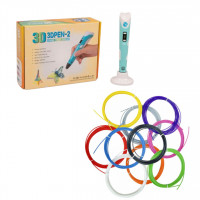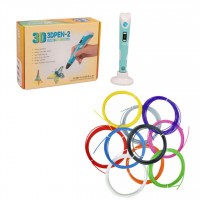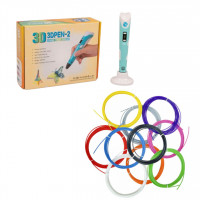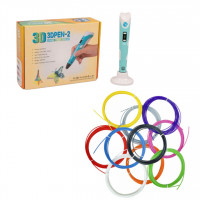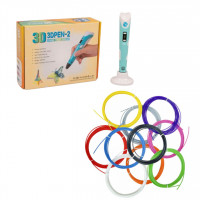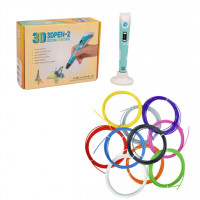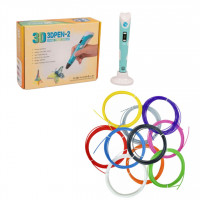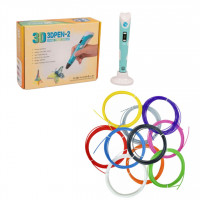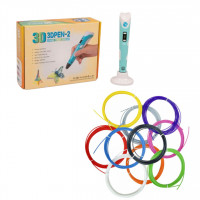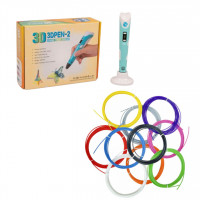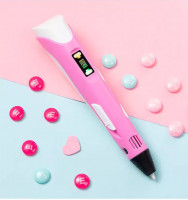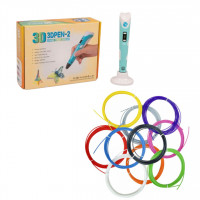
The 3D pen is not just a creative gadget: it is a powerful teaching tool that transforms abstract concepts into tangible objects. In this article, we propose five structured activities with clear learning objectives and practical instructions, ready to use in the classroom.
Activity 1: Building Platonic Solids (Maths/Geometry)
Level: primary and secondary school. Aim: To understand the properties of regular solids (tetrahedron, cube, octahedron, dodecahedron, icosahedron) by physically constructing them. The students first draw the flat faces on paper, then join them with the 3D pen to create the edges. This makes concepts such as vertices, edges, faces and Euler's relation (V - S + F = 2) concrete. Materials: 3D pen, PLA filament in several colours, printed stencils of the faces.
Activity 2: The water cycle in 3D (Science)
Level: primary school. Objective: to visualise the water cycle (evaporation, condensation, precipitation, collection) in a 3D model. Each student creates an element of the cycle with the 3D pen: mountains, clouds, raindrops, rivers. The pieces are then assembled into a class diorama. The activity combines science, art and group work. Materials: 3D pen, blue, white and green PLA filament, cardboard base.
Activity 3: Design your own bridge (Technology/Engineering)
Level: Lower and upper secondary school. Objective: to understand the principles of structural strength by designing and building a bridge with the 3D pen. Students first draw the design on paper, then build it in 3D. They test different structures (beam, arch, truss) by loading them with increasing weights. The bridge that holds the most weight with the least material wins. Materials: 3D pen, PLA filament, balance, graduated weights.
Activity 4: Molecular models (Chemistry)
Level: Lower and upper secondary school. Aim: to construct three-dimensional models of molecules (water H₂O, carbon dioxide CO₂, methane CH₄, glucose) to understand structure, bond angles and molecular geometry. Different colours are used for each element: red for oxygen, white for hydrogen, black for carbon. The models remain in the classroom as a visual reference. Materials: 3D pen, PLA filament in several colours, cards with molecular structures.
Activity 5: From drawing to object - design thinking (Technology/Art)
Level: all. Objective: to experience the complete design thinking process (empathy, definition, conception, prototyping, testing) using the 3D pen as a rapid prototyping tool. Students identify an everyday problem (e.g. a pen holder, a smartphone holder, a backpack hook), draw it on paper, prototype it with the 3D pen and test it with peers. Feedback leads to iterations and improvements. Materials: 3D pen, PLA filament, brainstorming sheets.
Organisational tips for the teacher
Provide 1 pen per 2-3 students to ensure sufficient time for use. Sessions of 60-90 minutes work better than short sessions. Always start with 10 minutes of free practice before the structured activity. Have spare filament ready: each student consumes about 5-10 metres per activity. Document the results with photos for the teaching portfolio.
3D pens and materials at DHM-online
At DHM-online you will find 3D pens and 1.75 mm PLA filament in all colours, ideal for teaching. For school purchases via MEPA or for quotes on complete classroom kits, contact the sales team at DHM.
Frequently asked questions: Educational activities with the 3D Pen
1. How can geometric solids be taught with the 3D pen?
The activity on Platonic solids makes the transition from plane to volume intuitive. Students draw faces (e.g. triangles or squares) on a flat stencil and then use the 3D pen as a "soldering iron" to join the edges in space. This method facilitates understanding of Euler's relation ($V - S + F = 2$) because the students touch each vertex, edge and face as they construct the solid.
2. What are the advantages of creating molecular models in 3D compared to drawing?
Chemistry often requires a three-dimensional view that is difficult to achieve on paper. By using different coloured filaments (CPK standard: black for Carbon, red for Oxygen, white for Hydrogen), students can reproduce the actual molecular geometry and bond angles. The result is a physical model that helps to memorise the structure of complex molecules through tactile and visual memory.
3. Can the 3D pen be used for engineering and structural strength tests?
Certainly. A classic activity is the bridge challenge: students design lattice or arch structures and build them with the 3D pen. Afterwards, the models are subjected to load tests with graduated weights. This teaches the concepts of tension and compression, demonstrating how the shape of a structure affects its ability to bear weights, just like in a real civil engineering project.
4. How many metres of filament are needed for a classroom teaching session?
On average, for a structured activity of approximately 60-90 minutes, each student consumes between 5 and 10 metres of PLA filament. It is advisable to have spools of different colours on hand to stimulate creativity and enable the distinction of parts in scientific or technological models. PLA is the material of choice for schools because it is non-toxic and biodegradable.
5. How to integrate the 3D pen into the Design Thinking process?
The 3D pen is the perfect tool for the rapid prototyping phase. Students can immediately transform a brainstormed idea into a physical object (e.g. a phone stand or a hook). This allows them to test the prototype immediately, receive feedback from their peers and make changes in real time, simulating the product development cycle used in modern companies. At DHM-online complete class kits and filament refills are available for purchase via MEPA.