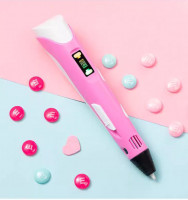
The 3D pen is one of the most intuitive and engaging tools for introducing 3D printing and 3D thinking in schools. Unlike a 3D printer that requires modelling CAD and slicing, the 3D pen allows you to draw directly in space, making 3D creation accessible even to young children.
How a 3D pen works
The principle is the same as FDM 3D printing, but in a hand-held format. A plastic filament (typically 1.75 mm PLA) is inserted into the pen, heated by an internal element and extruded through a nozzle. The material cools rapidly on contact with air, solidifying and maintaining the given shape. The user controls the extrusion speed and can draw both on flat surfaces and in three-dimensional space.
Why use it in education
The 3D pen develops fundamental transversal skills: spatial thinking and three-dimensional visualisation, creativity and design skills, fine motor skills and hand-eye coordination, understanding materials and their properties (melting, solidification, plasticity), and problem-solving through rapid prototyping. It is an ideal tool for introducing students to the world STEM in a playful and concrete way, without the barrier of digital modelling.
Compatible materials
Most 3D pens use 1.75 mm PLA filament, the same as FDM 3D printers. PLA is the ideal choice for school use because it is non-toxic, biodegradable and does not emit unpleasant odours during use. Some pens also support PCL (polycaprolactone), a material that melts at a lower temperature (around 60 °C) and is therefore even safer for young children.
Activities STEM with the 3D pen
Primary school
Drawing solid geometric shapes: cubes, pyramids, spheres. Creating 3D letters and numbers for learning to write. Construction of models of simple molecules for science. Decoration and customisation of everyday objects.
Secondary school
Modelling geometric figures for mathematics (polyhedra, rotating solids). Construction of architectural and structural models. Creation of prototypes for technology projects. Studying the strength of materials with lattice structures.
Secondary school and university
Rapid prototyping of concepts and design ideas. Creation of anatomical models for biology. Visualisation of three-dimensional graphs for mathematics and physics. Complement 3D printing for details and quick repairs.
Tips for use in the classroom
Ensure adequate ventilation in the room, even though PLA does not emit harmful fumes. Supervise younger children: the nozzle reaches high temperatures. Start with flat stencil exercises before moving on to 3D drawing in space. Provide a silicone mat as a working base to protect the stencils. Have PLA filament available in different colours to stimulate creativity.
3D pens and filament at DHM-online
At DHM-online you will find 3D pens suitable for educational use and a large selection of 1.75 mm PLA filament in all colours. For school purchases via MEPA, contact the sales team at DHM for customised quotations and support in the purchasing process.
FAQ: Frequently asked questions about the 3D Pen at school
1. What is the difference between a 3D pen and a 3D printer for educational use?
The main difference lies in the approach to creation: whereas the 3D printer requires the use of modelling software CAD and programmes from slicing, the 3D pen allows three-dimensional objects to be drawn freehand. It is a manual rapid prototyping tool that eliminates digital barriers, making learning spatial thinking immediate and accessible even to primary school children without computer skills.
2. Which 3D pen filament is safest for children?
The most suitable material for the school environment is the 1.75 mm PLA filament. PLA is a bioplastic that is biodegradable, non-toxic and does not emit harmful fumes during extrusion. For younger children (kindergarten or first years of primary school), we recommend the use of 3D pens compatible with PCL filament, which melts at low temperatures (around 60°C), drastically reducing the risk of accidental burns.
3. How to use the 3D pen for teaching subjects STEM?
The 3D pen is a great tool for activities STEM because it allows abstract concepts to be visualised. In mathematics, it can be used to construct polyhedra and rotation solids; in science to create molecular or anatomical models; in technology to test the strength of lattice structures. It facilitates empirical learning through direct manipulation of volumes and the development of fine motor skills.
4. Is the 3D pen hot? Safety precautions in the classroom
PLA-loaded 3D pens operate at temperatures between 180°C and 210°C, so the nozzle (the tip) reaches high temperatures and must not be touched. For safe use at school, adult supervision, the use of a silicone mat to protect desks and ventilation in the room are essential. For younger children, there are 'low-temp' models that use low-temperature materials.
5. Where to buy 3D pens and filaments with electronic invoicing or MEPA?
For schools and public administrations, 3D pen kits and filament refills can be purchased via the MEPA (Public Administration Electronic Marketplace) portal. On specialised platforms such as DHM-online, teachers and purchasing managers can request customised quotations and dedicated assistance to complete institutional purchasing procedures and electronic invoicing.