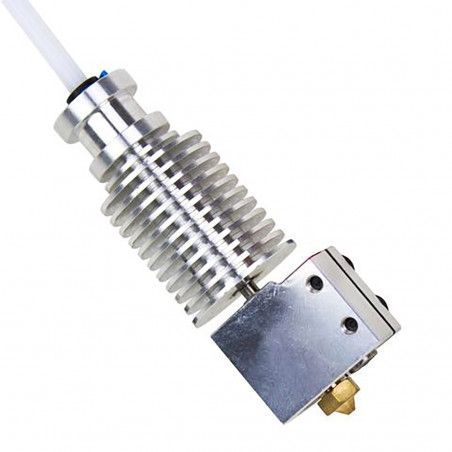
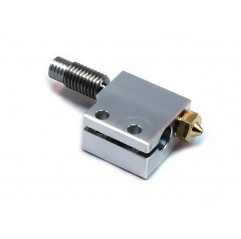
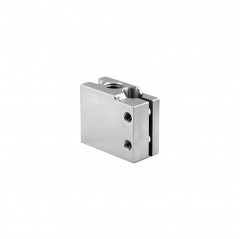
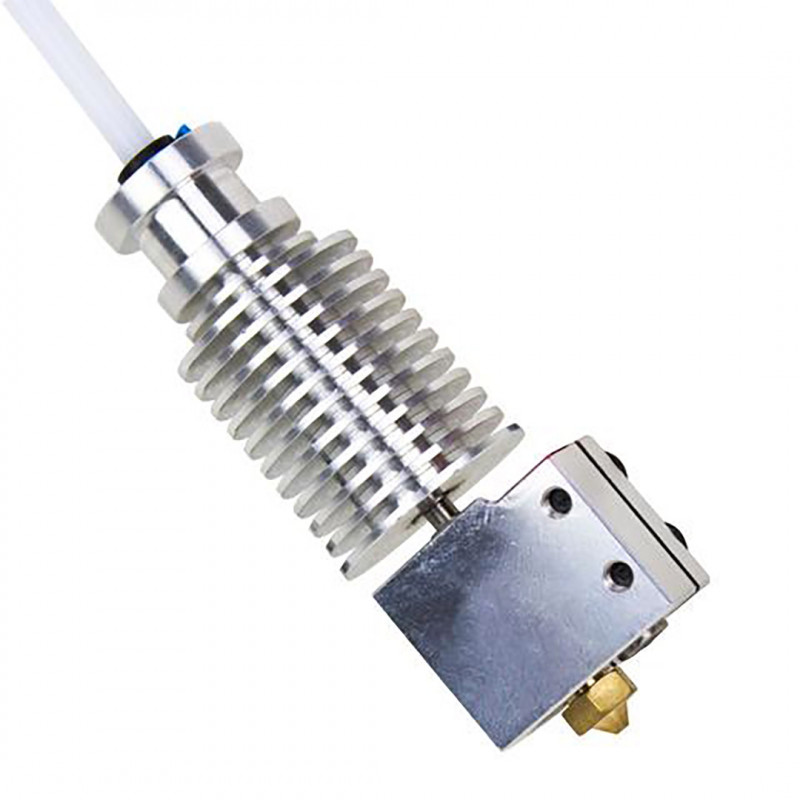
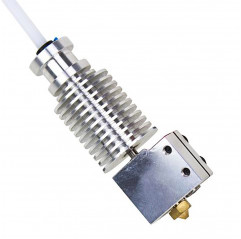
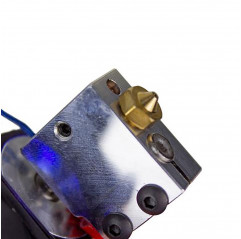
Volcano HotEnd is the solution to speed up printing. Volcano HotEnd has a volumetric flow rate that is 3 times higher than the standard V6. Volcano HotEnd allows you to print larger, stronger parts, faster. If you have a printer with a large print volume, then the Volcano HotEnd is perfect. Customizable Volcano HotEnd maintains the highest possible compatibility with the E3D ecosystem. You can choose from a wide range of upgrades including temperature sensors and heating cartridges, as well as different nozzle materials and sizes for any use case. Faster With its wider fusing zone, Volcano HotEnd allows users to print thicker and wider layers that result in significantly reduced print times. Stronger In addition to reducing printing times, the thick layers printed by Volcano have greater adhesion and bond together with greater strength. Printed parts are extremely durable, less fragile and much stronger than standard prints. Larger As print volumes increase and interest in large 3D printed items such as furniture and automotive parts increases, there is a need to reduce overall print times. The Volcano heated block is designed to make printing large parts more efficient by allowing the use of larger nozzles and higher volumetric flow rates.
Faster Thanks to its larger melt zone, the Volcano HotEnd enables users to print thicker and wider tracks which results in dramatically reduced print times.
Stronger In addition to reduced print time, the thick tracks printed by Volcano have greater interlayer adhesion and bond to one another with improved strength. Parts printed are extremely strong, less brittle and feel much more sturdy than standard prints.
Bigger With the print volumes increasing and interest of larger 3D printed items such as furniture and automotive parts, comes a requirement to decrease the overall print time. The Volcano heater block was designed to make printing large parts more efficient by allowing the use of larger nozzle sizes and higher volumetric flow rates.
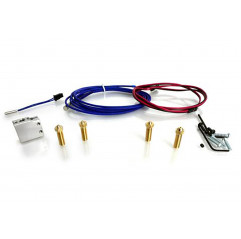
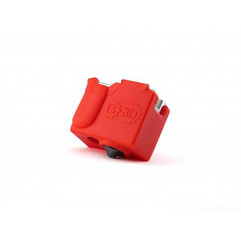
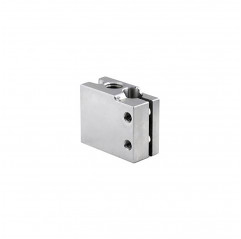
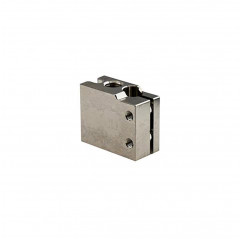
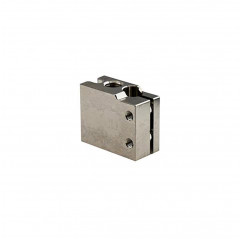
Key Features: - 3 times the volumetric flow rate of V6 HotEnd - Compatible with the E3D ecosystem - Maximum print temperature 285°C - All metal thermal cut Kit includes: - 1 x V6 heat sink 1.75 or 2.85 direct or bowden - 1 x Volcano aluminum heated block - 1 x Volcano 1.75 mm or 2.85 mm stainless steel throat - 1 x Volcano 0.8 mm brass nozzle 1.75 mm or 2.85 mm - 1 x 30W 12V or 24V cartridge - 1 x thermistor - 1 x extension cable for thermistor - 1 x collet clamp 1.75 mm 2,85 mm - 1 x Clip for 1,75 mm or 2,85 mm clamp - 1 x V6 fixing kit - 1 x PTFE tube - 1 x V6 fan channel - 1 x 30 x 10 mm fan 12V or 24V - 1 x M3 headless screw - 1 x M3 washer - 1 x thermal paste - 1 x Volcano sock - 1 x cable tie
For technical specifications please visit the wiki dedicated to E3D products: https://e3d-online.zendesk.com/hc/en-us Here you can find technical details and installation examples. To share opinions and questions, also technical, you can consult the dedicated forum: https://forum.e3d-online.com/ The object that you will receive can differ for some characteristics from that represented in photo, according to the production lot. Despite this, the functionality is maintained.
Qual è la differenza tra un estrusore Single Drive e uno Dual Drive?
L'estrusore Single Drive utilizza un solo ingranaggio motorizzato e un cuscinetto a pressione. Il sistema Dual Drive utilizza due ingranaggi controrotanti che afferrano il filamento da entrambi i lati, garantendo una forza di spinta doppia e riducendo drasticamente lo slittamento, specialmente con filamenti tecnici o velocità elevate.
Quando dovrei sostituire l'ugello (nozzle)?
L'ugello va sostituito quando si notano problemi di stampa, specialmente superficiali, o se il diametro del foro si è allargato a causa dell'usura (comune con materiali abrasivi). Un ugello in ottone usato con fibra di carbonio può rovinarsi in poche ore di stampa, mentre uno in acciaio temprato può durare mesi.
Perché il mio estrusore scatta (fa rumore di "clic") durante la stampa?
Il rumore di scatto indica che il motore non riesce a spingere il filamento. Le cause, tra le altre, possono essere un ugello parzialmente ostruito, una temperatura di stampa troppo bassa, o una velocità di estrusione eccessiva per le capacità termiche del tuo hotend, un meccanismo non adeguato al tipo di filamento utilizzato.