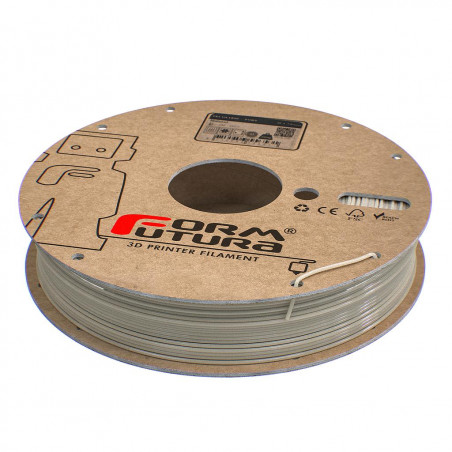
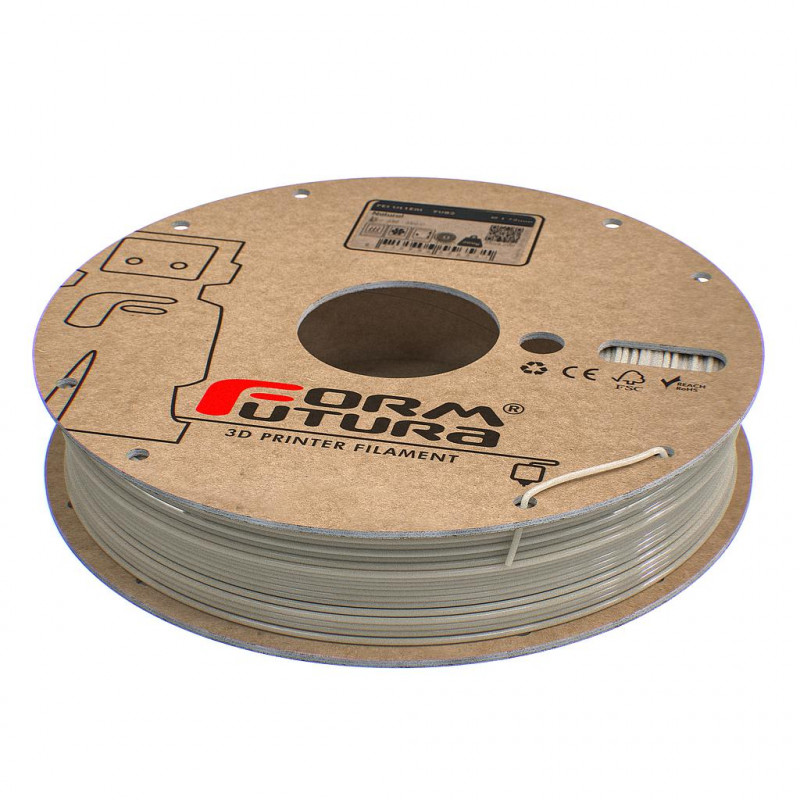
PEI ULTEM 9085 is an ultra-high-performance amorphous PEI (Polyether Imide) filament for 3D printing. It combines exceptional dimensional stability with good chemical resistance. The material has a glass transition temperature of 186°C.
PEI ULTEM 9085 is a flame retardant filament with low smoke emission. It meets UL 94 V-0 and 5VA standards. The material combines excellent interlayer adhesion, high dimensional accuracy, high impact resistance, durability and high tensile strength in one filament.
Key features
Glass transition temperature: 186°C
Excellent dimensional stability
Long-term hydrolytic stability
Excellent mechanical properties
Flame retardant with UL 94 V-0 and 5VA certifications
Low smoke emission and low smoke toxicity
Good chemical resistance
Applications
Electrical applications
Chemical-resistant components
High durability parts
Aerospace applications
Automotive applications
General printing guidelines *
Nozzle size: ≥ 0,4 mm
Height layer: ≥ 0.10 mm
Experience level: Expert
Print temperature: ± 350 - 390 °C
Fan speed: 0 - 25%.
Drying: +4 hours at max. 110°C
Heated plate: ≥ 120°C
Closed chamber: heated chamber at 90°C
Adhesion to platen: EasyFix No. VII
* The above settings are guidelines for finding optimal print settings. These ranges should work with most printers, but you can experiment outside these values if you feel it is suitable for your printer. There are many different types of printers, hot-end and offset, so it is difficult to provide universal settings that apply to all.
The item you receive may differ in some features from the one shown in the photo, depending on the production batch. Despite this, functionality is maintained.
Qual è il materiale migliore per pezzi che devono stare all'esterno?
L'ASA è il materiale consigliato per l'uso esterno. A differenza dell'ABS, l'ASA è altamente resistente ai raggi UV, non ingiallisce e mantiene le sue proprietà meccaniche anche sotto l'esposizione diretta del sole e degli agenti atmosferici.
Perché la mia stampa in PETG presenta molti "fili" (stringing)?
Il PETG è un materiale molto viscoso. Per ridurre lo stringing, è fondamentale calibrare correttamente la temperatura di stampa e la distanza di ritrazione. Inoltre, assicurati che il filamento sia asciutto, poiché l'umidità assorbita peggiora drasticamente questo fenomeno.
Posso mescolare resine di marche diverse?
In generale è sconsigliato, poiché ogni resina ha tempi di esposizione e composizioni chimiche differenti. Mescolarle potrebbe portare a fallimenti di stampa o a una polimerizzazione incompleta del pezzo.
Come si smaltiscono i residui di resina 3D?
La resina liquida è considerata un rifiuto speciale. Non deve mai essere gettata negli scarichi domestici. È necessario polimerizzare i residui liquidi (esponendoli al sole o a lampade UV) fino a renderli solidi, dopodiché possono essere smaltiti seguendo le normative locali sui rifiuti plastici speciali.